


What should a small non-profit look for in silent auction software?
Most small organizations run one or two auctions a year with a volunteer committee and a small staff. These are the questions we would ask of any tool, including ours.
1. Cost per item or per event, or a percentage?
Pricing comes in three shapes: a flat license or package, a percentage of what you raise, or free to you and funded by tips your guests are asked to leave. A flat price rewards a large event and punishes a small one. A percentage scales down with you, but check what it is a percentage of. A tip model costs you nothing directly, but your guests are asked to pay the software company at checkout. Run the numbers on your own event.
2. Who pays the card fees?
Card processing is usually separate from the platform fee. Ask the rate, whether it sits on top of a platform fee, and whether guests can choose to cover it.
3. Can guests bid from their own phones, with a maximum bid?
Guests should be able to open a link or scan a code and bid without installing an app. A maximum bid (also called a proxy or auto bid) lets a guest set the most they will pay and have the system bid for them, which keeps them in the running while they are at dinner.
4. How fast is checkout at the end of the night?
The checkout line is where goodwill runs out. Look for cards saved early, winners charged automatically or in one batch, and a clear way to handle a declined card without charging anyone twice.
5. Does auction revenue land on the same donor record?
If the auction runs on a separate system, the person who renewed a membership in March, gave in June and won the wine basket in October is three records in two places. Ask whether winning bids and paddle-raise gifts attach to the same contact as memberships and donations, or arrive later as an export.
6. Do tax receipts separate fair market value from the gift?
For an auction item, generally only the amount paid above its fair market value can be deductible. Look for the value recorded on each item and shown on the receipt, and confirm your own receipting practice with your tax advisor.
7. Is there a room screen?
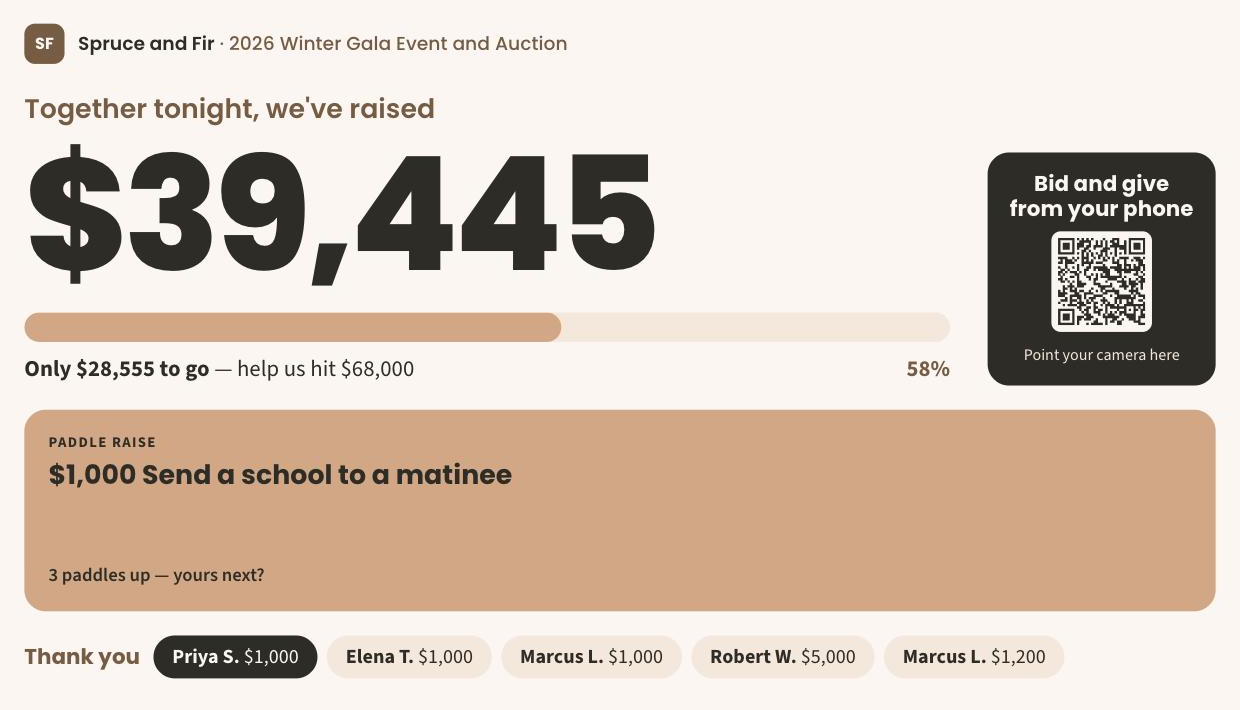
At an in-person event, a screen showing the total against the goal, top bids or the paddle raise keeps the room engaged and reminds people to bid.
Seven silent auction options compared
Every competitor fact below comes from that company's own website, checked on 30 September 2026, with a link to the page. Pricing changes, so confirm before you decide. Where a page did not say something, we left it out rather than guess.
Clerestory
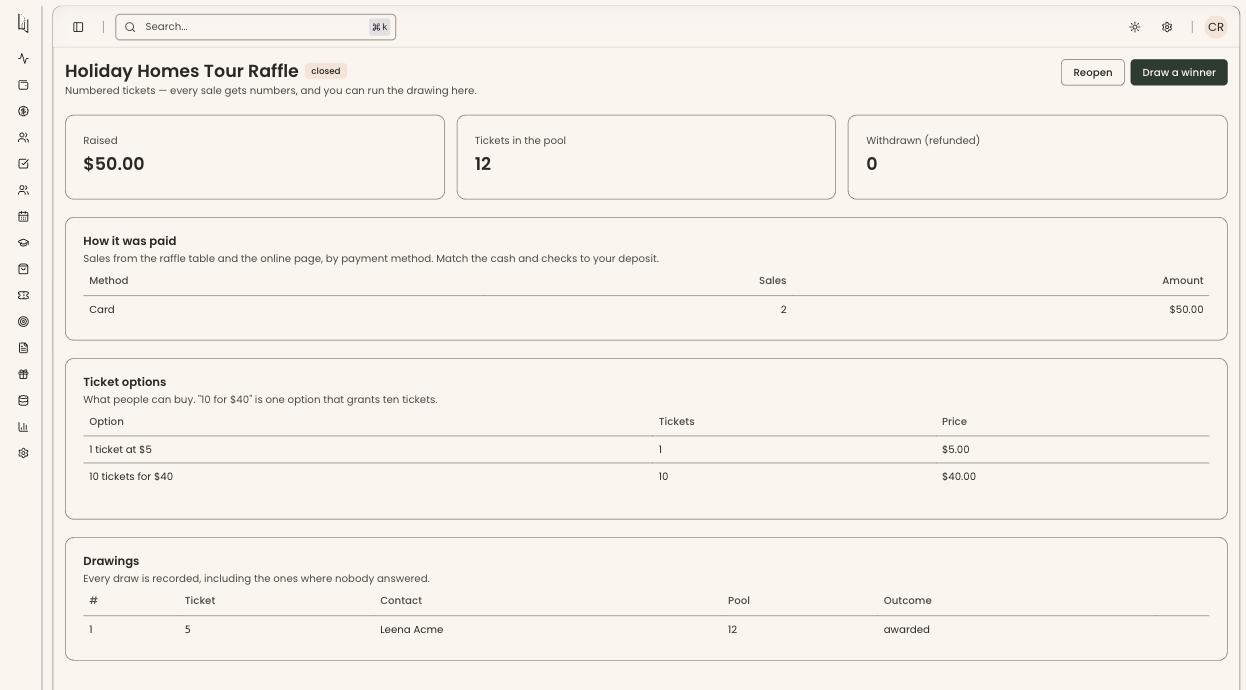
Clerestory is our product: a CRM and payments platform for non-profits, with auctions in every account. The auction lives on the event itself, so tickets, guests, bids, the paddle raise and payments land on the same records as the rest of your organization's year.
- Pricing: 3% per successful transaction on your own Stripe account, plus Stripe's processing. No license, per-seat or module fee, no minimum or contract, and no event or per-bidder fee for auctions. Refunds return the 3%.
- Card fees: each bid and gift has its own box for the guest to cover the processing fee, and you choose whether it starts ticked.
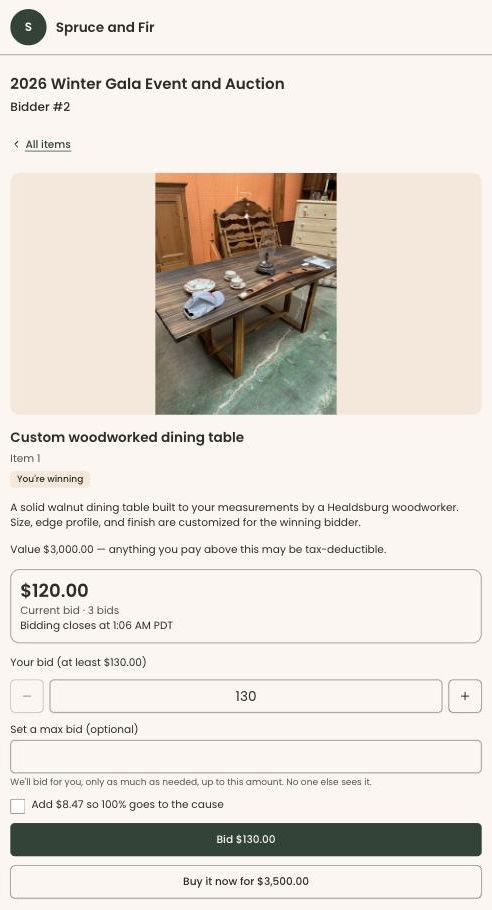
- Phone bidding: each guest gets their own bidding link and signs in with a code sent to their email. They can set a private maximum bid, use buy it now, and give to the paddle raise from their seat. Outbid alerts go by email.
- Checkout: one button charges every ready card, once per bidder number, and retrying is safe. A declined card can be retried, replaced, sent a pay link or marked paid by check or cash.
- Donor record: a paddle-raise gift is recorded as a donation in the donor's giving history. An auction win is charged to the household's paying contact and recorded as event revenue rather than giving.
- Receipts: one statement per guest showing, line by line, what was paid and how much is tax-deductible. Fair market value is locked when the win is recorded.
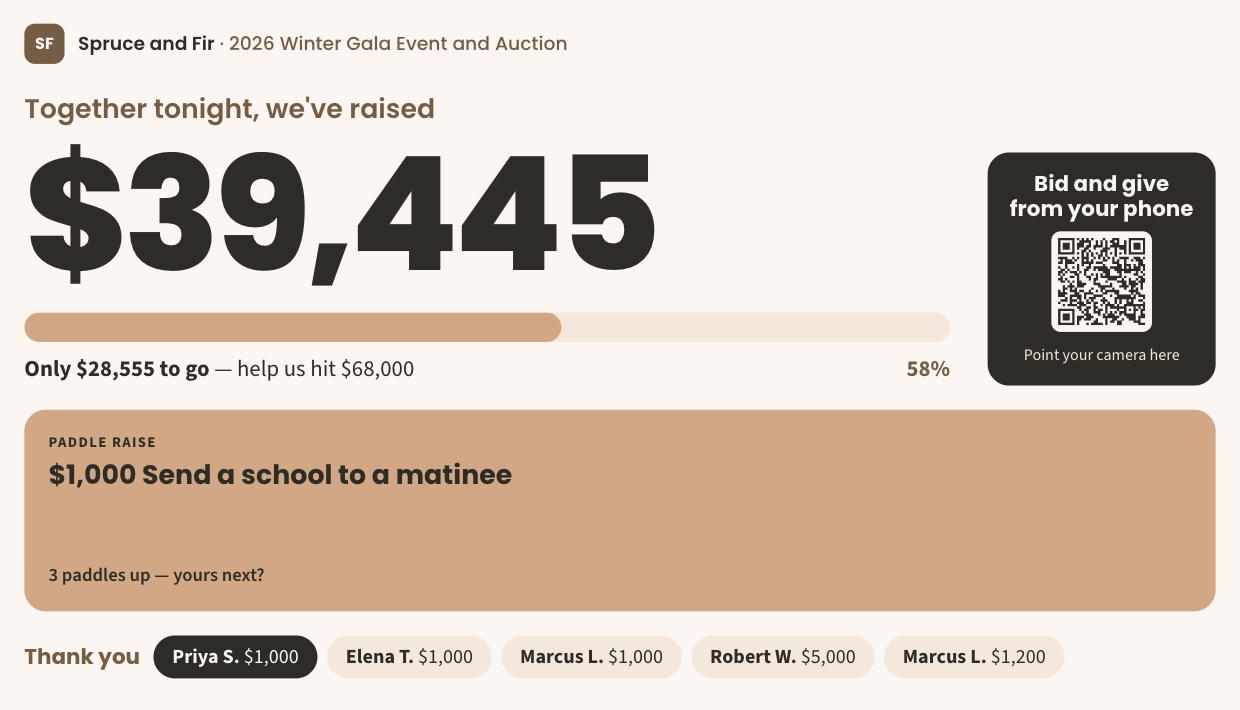
- Room screen: yes, with the total against your goal, a QR code to bid and give, the paddle-raise level being called and a thank-you to givers, never by full name.
Who it fits: organizations holding an in-person gala or benefit that want the auction on the same donor records as memberships and donations. See how auctions work in Clerestory, start to finish.
Givebutter
Pricing and card fees: "0% platform fees across all campaign types when tips are enabled," and Givebutter says non-profits don't pay processing fees when tips are on. With tips off, a flat 3% platform fee applies plus 2.9% + 30¢ for cards, which you can ask donors to cover. Auctions are on the free plan (Givebutter pricing, as of September 2026).
Bidding: bidders can set a max bid and the system bids for them in set increments, and winners can be charged automatically (Givebutter auctions, as of September 2026).
Who it fits: organizations comfortable with a tip-funded model that already run other Givebutter campaigns. See Clerestory vs Givebutter.
Zeffy
Pricing and card fees: "No platform fees. No add-on fees. No credit card fees. No transaction fees." Zeffy is funded entirely by optional tips from donors, who are never required to tip (Zeffy auction software, as of September 2026).
Bidding: guests bid from their phones with no app and no account. They can set a maximum and let auto-bidding hold their place, and outbid alerts go by email and text. When the close time passes, Zeffy charges the winning bid to the card already entered and emails a receipt (same page, as of September 2026).
Who it fits: the smallest budgets, where zero cost to the organization matters most. See Clerestory vs Zeffy.
GalaBid
Pricing and card fees: tip-funded: winners and donors "are prompted to tip GalaBid during checkout," with no penalty if they decline. Payments go directly into your own Stripe account (GalaBid silent auctions, as of September 2026).
Bidding: browser-based with no app (GalaBid platform). Guests can set a maximum and let GalaBid bid up to it, outbid alerts go by SMS, and top bids, countdowns and goals can be shown on big screens (GalaBid silent auctions, as of September 2026).
Who it fits: events that want a room display and text alerts on a tip-funded model.
Bidding Owl
Pricing and card fees: a 5% performance fee only on items that receive online or mobile bids, so a $100 winning bid costs $5. Setup, bid sheets, ticket sales and donations are free, and you can add an optional supporter contribution (a buyer's premium). Payments run through Stripe or PayPal, whose processing fees apply (Bidding Owl pricing, as of September 2026).
Bidding: online and mobile bidding from any device, SMS and email outbid notifications, and checkout and invoicing for in-person events (Bidding Owl FAQ, as of September 2026).
Who it fits: auctions that mix paper bid sheets with some online bidding, since only online-bid items carry the fee.
32auctions
Pricing and card fees: a free plan with up to 20 items, one image per item, third-party ads, online-only events and self-managed payments. Paid upgrades exist, but the page showed no dollar amounts. Collecting payment through 32auctions costs "2.9% + $0.40 per online payment or donation, in addition to the Stripe or PayPal transaction fee" (32auctions pricing, as of September 2026).
Bidding: by link or QR code with nothing to install, with proxy bids and buy now (32auctions free software; pricing, as of September 2026).
Who it fits: a small online-only auction of 20 items or fewer.
Handbid
Pricing and card fees: Handbid "does not charge a percentage of funds raised." Pricing is a custom quote for a term, a one-year license being standard, with unlimited items, guests and bidders. Cards are 3.5% + $0.30 (American Express 3.95% + $0.30), ACH 1.5%, with an optional prompt for bidders to cover processing (Handbid pricing, as of September 2026).
Bidding: mobile bidding for in-room, online or hybrid events (Handbid, as of September 2026).
Who it fits: organizations running several auctions a year that are ready for an annual license. No free option is listed.
Silent auction software pricing at a glance
As of September 2026, from the vendor pages linked above.
| Option | Pricing model | Card fees | Phone bidding | Free? |
|---|---|---|---|---|
| Clerestory (ours) | 3% per transaction; no event or bidder fee | Stripe's; guest can cover | Yes, max bid | No |
| Givebutter | 0% with tips; 3% without | None with tips; 2.9% + 30¢ without | Yes, max bid | Yes, tip-funded |
| Zeffy | No fees; tip-funded | None | Yes, max bid | Yes, tip-funded |
| GalaBid | Tip-funded | Your Stripe account | Yes, max bid | Yes, tip-funded |
| Bidding Owl | 5% on online-bid items | Stripe or PayPal | Yes | Paper-only items |
| 32auctions | Free to 20 items; paid upgrades | 2.9% + $0.40 plus processor, or self-managed | Yes, proxy bids | Up to 20 items |
| Handbid | Annual license by quote | 3.5% + $0.30 | Yes | No |
On $10,000 of winning bids, a 3% fee is $300 before processing, and a 5% fee on online-bid items is up to $500. An annual license is a fixed number, so divide it by the auctions you will actually run. For fees beyond auctions, see non-profit fundraising platform pricing in 2026; for how auctions sit beside memberships, donations and raffles, see Clerestory's features or the pages for museums and historical societies and service clubs.
What Clerestory does not do
- No free plan. Clerestory charges 3% per transaction. If a tip-funded tool meets your needs, it will cost your organization less.
- No text alerts. Outbid alerts go by email.
- No offline mode. If the venue's internet fails, paper bid sheets and Enter results are the backup.
- No tap-to-pay on an iPhone. Card readers are Stripe card readers.
- No QR scan at the door. Check-in is by search.
- Not a standalone auction site. Auctions live on an event inside a full CRM. If you only want a one-off auction with no donor records, a dedicated auction tool may be simpler.
If Clerestory looks like a fit, request a demo and we will walk through an auction with your event in mind.
Frequently asked questions
What is the best silent auction software for a small non-profit?
It depends on your event. For a small online-only auction with no budget, tip-funded or free-tier tools such as Zeffy, Givebutter, GalaBid or 32auctions cost the organization little or nothing, as of September 2026. For an in-person gala where you want bids, paddle-raise gifts and payments on the same donor records as memberships and donations, Clerestory, our product, charges 3% per transaction with no event or bidder fee.
Is there free silent auction software for non-profits?
Yes. As of September 2026, Zeffy charges the organization no fees and is funded by optional donor tips, Givebutter charges 0% platform fees when tips are enabled, GalaBid is funded by optional tips, and 32auctions has a free plan for up to 20 items with third-party ads. Check each vendor's site for current terms.
Who pays the credit card fees in a silent auction?
It varies by tool. Some cover processing when donors tip, some pass through a set rate, and most let guests choose to cover the fee at checkout. In Clerestory each bid and gift has its own box for the guest to cover the processing fee, and the organization chooses whether it starts ticked.
Is the amount paid for a silent auction item tax-deductible?
Generally only the amount paid above the item's fair market value can be deductible. Look for software that records each item's value and shows the deductible portion on the receipt. Clerestory locks fair market value when the win is recorded and sends one statement per guest showing it line by line. Confirm your practice with your tax advisor.