


A raffle looks simple: sell tickets, draw one, hand over the prize. The software is the easy part. The hard parts are the ones a platform can't do for you: knowing whether your state requires a license, whether you may sell tickets online at all, and how to explain to a buyer that their ticket is not a donation.
We checked every competitor fact on this page against the company's own website or help center on 30 September 2026, and each one links to the page it came from. Pricing changes, so treat anything here as accurate as of September 2026 and confirm it before you sign up. We did not use review sites or comparison sites.
One disclosure up front: Clerestory is our product. We have tried to describe it with the same care, including what it does not do.
Is it legal to sell raffle tickets online?
It depends on where you are, and the answer is set locally, not by the software. In the United States, raffle law is written by each state, and some states hand parts of it to counties or cities. Many states require a non-profit to hold a license or register before it runs a raffle, and some restrict or prohibit selling raffle tickets online.
The platforms say the same thing in their own words:
- RallyUp: "each state (and sometimes county or city) has its own regulations," and "you may need a license or permit depending on your state's laws." RallyUp also writes that "states like Alabama, California, and Hawaii prohibit online raffles" (RallyUp raffles page, as of September 2026).
- Givebutter: "Each state has unique laws regarding the online sale of raffle tickets. Please check with your state's office of charitable gaming before selling raffle tickets on Givebutter" (Givebutter help center, as of September 2026).
- Zeffy: "Check first whether raffles and online ticket sales are permitted where you are, because that varies by state and province" (Zeffy online raffle page, as of September 2026).
Where to check your state's rules
Start with your state attorney general or its gaming or charitable gaming office. Three official examples, to show how different the rules look (this is not a complete list, and rules change):
- California. The Attorney General's raffle registration checklist says an eligible non-profit must register with the Department of Justice and pay a $30 fee, should submit the application at least 60 days before its first raffle, and must file an annual raffle report by February 1 of the following registration year.
- Pennsylvania. Raffles fall under the Small Games of Chance Act. The Allegheny County Treasurer lists a $125 license valid for one year, a $25 one-month license and a $25 special raffle permit.
- Minnesota. The Gambling Control Board publishes its own guidance on excluded raffles and Start Simple raffles.
If the rules are unclear for your situation, ask your state's gaming authority or a lawyer before you sell. RallyUp gives the same advice: "It's best to consult legal counsel to ensure compliance with local requirements."
Are raffle tickets tax-deductible?
No. A raffle ticket buys a chance to win, so it is not tax-deductible. Whatever software you use, make sure the confirmation a buyer receives is not worded as a donation receipt, and that raffle revenue is reported apart from gifts.
What to look for in raffle software
- Where you can sell. An online page is standard. Check whether you can also sell at a table on the night, and whether cash and checks get recorded in the same place as card sales. If they don't, reconciling the cash box becomes a spreadsheet job.
- How the winner is drawn. Some platforms draw inside the product; others ask you to export ticket numbers and use a separate random number generator. Either can be fine. What matters is that you can show afterwards how the draw was done, and that refunded tickets can't win.
- What it really costs. Separate the platform fee from card processing, and look at who pays. A "free" platform funded by a suggested tip at checkout moves the cost to your buyers.
- 50/50 support. If you run 50/50s, check whether the software tracks the pot and pays it out, or leaves that to you.
- Receipts and reporting. Raffle money should count as money raised, never as a gift, and never receive a tax receipt.
- Legal help. Expect none. Every platform we checked puts compliance on the organization.
Five raffle platforms compared
Clerestory
Who it fits: non-profits that run raffles alongside memberships, events, admissions or auctions and want every sale, including cash and checks, in the same system as their donors.
Pricing: no extra charge for raffles. They are part of every Clerestory account at the same 3% per transaction as everything else, on your organization's own Stripe account, plus Stripe's processing. There is no license fee and no contract.
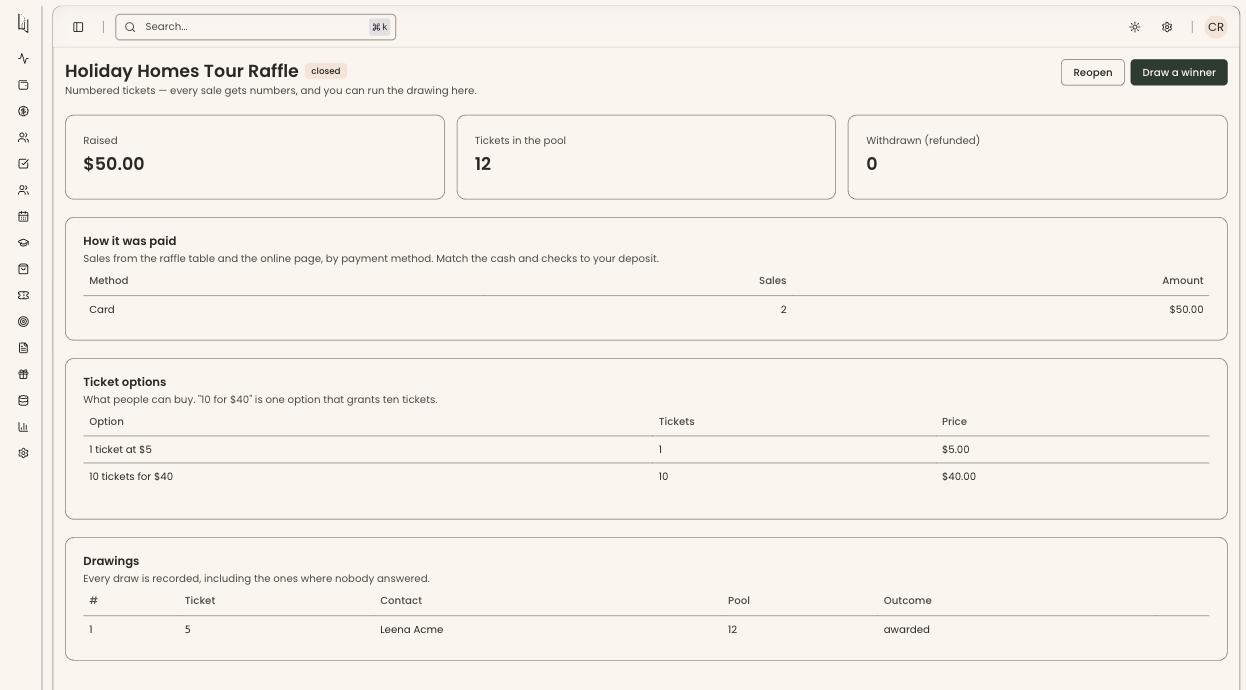
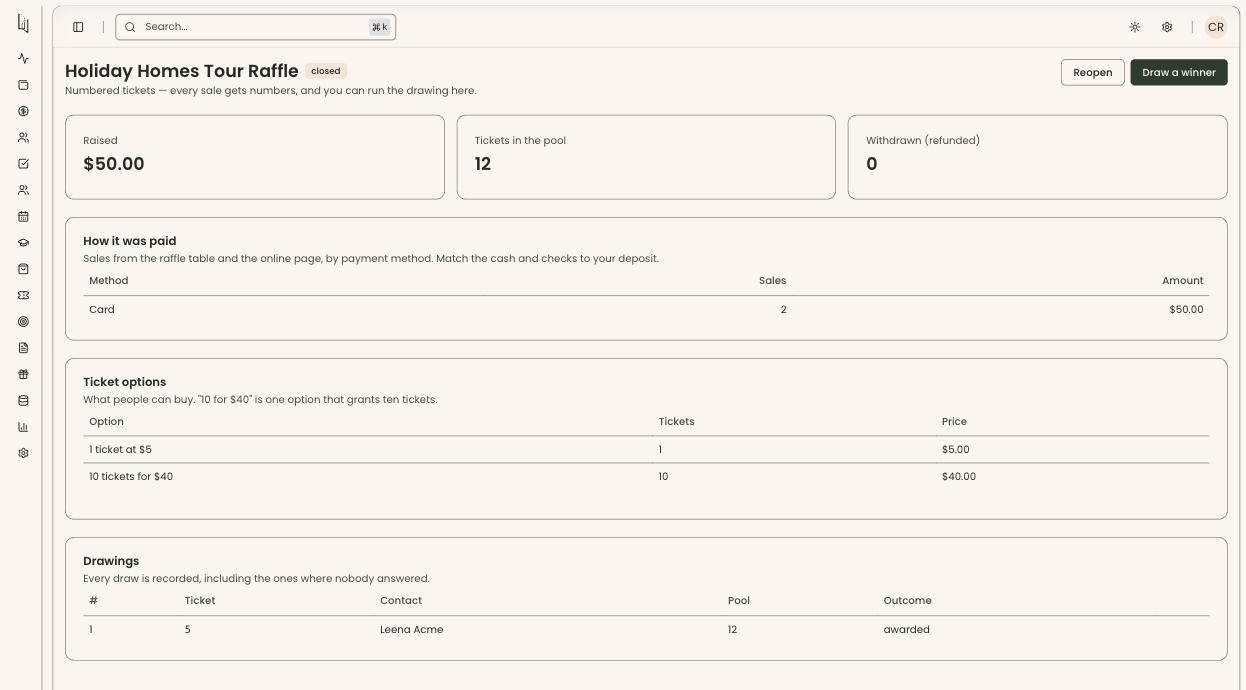
What it does well: each raffle has its own online page, a table screen for a tablet or laptop, and a lane on the kiosk. At the table you can take payment by card reader, by typing the card in, by the buyer paying on their own phone from a QR code, by cash, or by check with the check number recorded. Tickets can be singles or bundles, such as 10 for $40. In a numbered raffle, Draw a winner picks a ticket with a cryptographically random choice; refunded tickets and tickets that have already won are never in the pool, and every draw is recorded before anyone sees the result. Raffle money has its own line in revenue reporting and never counts as giving. More in how raffles work in Clerestory.
Limits: covered in full in the section on what Clerestory does not do, below.
RallyUp
Who it fits: organizations that run raffles as a main event, including 50/50s and larger prize raffles.
Pricing (as of September 2026): two options. On Free pricing there is "no Platform Fee," processing is "1.9%-2.9% + $0.30 per transaction," and donors can tip RallyUp. On Flex pricing, "Raffles and Sweepstakes are 6.9%," with the option to "Ask or require donors to cover the platform fee" (RallyUp pricing options).
What it does well: prize raffles, 50/50 raffles and what it calls enhanced 50/50s with other splits, such as 70/30. It says "You can sell online and paper tickets, while skillfully tracking both," and draws by "certified random draw" with automatic winner notification (RallyUp raffles page).
Limits: the Flex raffle rate of 6.9% is the highest published platform rate on this page. Compliance is left to you.
Zeffy
Who it fits: smaller organizations that want no fee on their side and are comfortable drawing outside the ticketing tool.
Pricing (as of September 2026): "completely free for nonprofits - no platform fees, no credit card fees, no fees period!" Zeffy "relies entirely on optional tips from your donors" (Zeffy online raffle page). The cost of the platform is paid by buyers who leave a tip. See our Clerestory vs Zeffy comparison for more on how that works.
What it does well: online ticket sales, 50/50s with a sales target and a thermometer, and tickets numbered as they sell (Zeffy online raffle page, as of September 2026).
Limits: Zeffy states that it "is not an Electronic Raffle System, as we currently do not offer a service for drawing a winner," and recommends exporting ticket numbers to "an external drawing service" (Zeffy help center, as of September 2026). It also says it "can't provide legal or compliance advice."
Givebutter
Who it fits: organizations already using Givebutter for events that want to add raffle tickets to an event page.
Pricing (as of September 2026): "0% platform fees across all campaign types when tips are enabled. If you disable tips, a flat 3% platform fee applies," plus standard processing of 2.9% + 30¢ for cards (Givebutter pricing).
What it does well: "Raffle tickets are created like all other tickets on an Event campaign," and each ticket gets a unique number (Givebutter help center).
Limits: the draw happens outside the ticket sale; Givebutter points you to its random number generator tool. Our Clerestory vs Givebutter comparison covers the wider differences.
GalaBid
Who it fits: organizations that want a dedicated raffle and auction tool with a live-event draw display.
Pricing (as of September 2026): "Use GalaBid software to sell your online raffle tickets free of charge." A "suggested tip to cover GalaBid's costs is added to the online ticket price. Purchasers can opt out or change the tip amount." Payments run on Stripe, and you can "Absorb the Stripe fees or pass them on to ticket purchasers" (GalaBid online raffle page).
What it does well: a "certified random number generator" and a "virtual draw projector display" for the room.
Limits: for 50/50s, "funds are not automatically distributed to the winner. The raffle administrator is responsible for collecting and distributing the raffle prize." And "Raffle ticket sellers are required to check and abide by local laws before running an online raffle on GalaBId."
Side-by-side comparison
| Clerestory | RallyUp | Zeffy | Givebutter | GalaBid | |
|---|---|---|---|---|---|
| What the organization pays | 3% per transaction plus Stripe processing | Free: processing only, buyers may tip. Flex: 6.9% for raffles | Nothing; buyers may tip | 0% with tips on; 3% plus processing with tips off | Software free; Stripe fees, which you can pass on |
| Checkout tip to the platform | No | On Free pricing | Yes, optional | Yes, unless turned off | Yes, added to ticket price |
| Draw inside the product | Yes, recorded | Yes | No, external tool | No, separate generator | Yes |
| 50/50 raffles | No built-in pot | Yes, including other splits | Yes | Not documented in the pages we checked | Yes; you pay out the winner |
| Checks your state's raffle law | No | No | No | No | No |
Competitor details as of 30 September 2026, from the pages linked above. For fees across the wider category, see our non-profit fundraising platform pricing guide.
What Clerestory does not do
- It does not check state raffle laws. Raffle law varies from state to state, so check the rules that apply to you before you sell. Clerestory does not check them for you.
- No built-in 50/50 pot. Each raffle has one prize description, so for a 50/50 you work out the winner's share from the raffle's total yourself.
- No free tickets. Raffle tickets cannot be given away free.
- One prize per raffle. Multiple winners are drawn as multiple draws.
- No text messages. There are no text-message notifications; ticket numbers and winner notices go by email.
If your raffle sits inside a gala, auctions in Clerestory run on the same guest records. Our pages for service clubs and churches show how a raffle fits alongside the rest of their fundraising.

Want to see a raffle drawn? Request a Clerestory demo.
Frequently asked questions
What is the best raffle software for non-profits?
It depends on how you run raffles. If raffles are your main fundraiser and you run 50/50s, a dedicated tool such as RallyUp or GalaBid fits. If you want no fee on your side, Zeffy and Givebutter are funded by buyer tips but draw the winner outside the ticket sale. Clerestory, which is our product, fits organizations that want raffles, cash and check sales and a recorded draw in the same system as their members and donors.
Is it legal to sell raffle tickets online?
It depends on your state. Raffle law is set by each state, and sometimes by counties or cities. Many states require a license or registration, and some restrict or prohibit online raffle sales. Check with your state attorney general or gaming authority before you sell.
Do I need a license to run a raffle?
In many states, yes. For example, California requires eligible non-profits to register with the Attorney General and pay a $30 fee, and in Pennsylvania the Allegheny County Treasurer lists a $125 annual Small Games of Chance license. Rules differ by state, so check yours.
Are raffle tickets tax-deductible?
No. A raffle ticket buys a chance to win, so it is not tax-deductible. Clerestory never sends a tax receipt for a raffle ticket and keeps raffle money out of giving, with its own line in revenue reporting.
Does Clerestory check state raffle laws?
No. Raffle law varies from state to state, and Clerestory does not check it for you, so check the rules that apply to your organization before you sell.
How much does raffle software cost?
As of September 2026: RallyUp's Flex rate for raffles is 6.9%, or processing only on its Free option with buyer tips; Zeffy charges the organization nothing and relies on buyer tips; Givebutter is 0% with tips on or 3% plus processing with tips off; GalaBid's software is free with a suggested buyer tip. Clerestory charges 3% per transaction plus Stripe's processing, with no license fee.
Can I run a 50/50 raffle in Clerestory?
You can sell tickets for one, but Clerestory has no built-in 50/50 pot. Each raffle has one prize description, so you calculate the winner's share from the raffle's total yourself.