



Working out what fundraising software costs is harder than it should be. Some vendors publish a full price ladder. Some publish a "starting at" figure with nothing to anchor it. Some publish nothing at all. And the headline number is rarely the whole number, because payment processing is usually priced somewhere else entirely.
So on 3 September 2026 we checked, on 4 September 2026 we added Neon CRM, and on 29 September 2026 we added Greater Giving. Every figure below was read off the vendor's own website or help center on one of those dates and is quoted verbatim, with the date noted where it matters. We have not used Capterra, G2 or any comparison site, because their numbers for this category are frequently stale and we are not willing to put an unverified figure next to a company's name.
One distinction to carry through the whole page: a published processing rate is not a price. It is what the card costs. What the software costs sits on top of it, and most vendors here quote the two separately or decline to publish the second at all. Neon CRM is the mirror image of that problem—it publishes what the software costs and not what the card costs. Almost everyone here publishes half the price. The half they leave out is what differs.
Is Zeffy really free?
For your organization, yes. Zeffy publishes "No transaction fees. No platform fees. No fees period." and states that "100% of all payments you receive through Zeffy go directly to your nonprofit." That is real, and we are not going to pretend otherwise.
The cost lands on your donors instead, and the mechanism is worth understanding. Zeffy describes its checkout tip this way: "Completely optional", "Separate from the nonprofit's donation", and—the part that matters—"Set to a suggested amount by default (donors can change it to zero)."
So the contribution is pre-selected. A donor who doesn't want it has to notice it and take it down to zero. A donor who doesn't notice, pays it. Non-profits posting on Zeffy's own feedback board have reported a default of around 17% on smaller gifts, on a request titled "Voluntary Contribution Defaults to $0" that carries 224 votes; Zeffy's product team closed that request in March 2026 having concluded its "current approach is the best balance."
In fairness, Zeffy publishes an average contribution of roughly 4%, so what donors actually pay is well below the default. Both figures are true, and quoting only the higher one would overstate it.
What you cannot do is adjust any of it: "The wording and suggested amounts in the contribution dropdown cannot be customized."
Two other mechanics, both in Zeffy's own words. You do not keep your own payment account—"We cannot connect your existing Stripe account to Zeffy as this would prevent us from covering the transaction fees on your behalf." And payouts run on their schedule: weekly by default, "every Monday", after an anti-fraud review, and "payouts cannot be triggered manually."
If online donations are the only thing you will ever take in, that is a trade worth weighing. It is also worth asking what happens the first time you sell a ticket to an event, take a class registration, or open the gift shop—and whether you want each of those living on a separate system with its own fees.
How much does Givebutter cost?
Givebutter has a free tier and, since recently, a paid one.
Free works on the same principle as Zeffy's: with optional donor tips switched on, platform and processing fees are 0%, "covered by 92% of donors" in their published figure. Switch tips off and the published rate is "a flat 3% platform fee ... plus standard processing fees (2.9% + 30¢ for cards, 1.9% + 30¢ for ACH)."
Givebutter Plus starts at $29 a month billed annually and is priced by contact count, rising through $79, $129, $179 and $279 a month to "Custom" above 10,000 contacts. Exceed a tier and you pay overage—"you'll only pay for additional contacts in increments of 100."
How much does Funraise cost?
Funraise publishes a free plan and a full fee schedule, and the two need reading together.
The free plan is $0 a month, with an eligibility condition in their own words: "Funraise is a free, fee-based, fundraising and donor management platform for organizations raising under $1 million annually." There are no setup fees either—asked "Are there setup fees?" their pricing page answers "Nope."
The fee schedule is where the price actually lives. The free plan carries a 5% platform fee. Premium plans, whose price is not published, carry 0–3%. Processing on both is 2.9% + 60¢, and American Express costs more again: "American Express payments incur an additional 1% fee."
Two figures stand out. 5% is the highest published platform fee of anyone on this page, ours included. And 60¢ per transaction is double the 30¢ that is standard elsewhere here, which bites hardest on small gifts: on a $25 donation, 60¢ on its own is 2.4%.
As with Zeffy and Givebutter, the free plan is free to the organization because the donor pays. Funraise's pricing page carries the badge "~90% of donors cover fees" and explains that "When donors cover fees, the additional amount covers both Funraise's platform fee and a portion of processing fees." Their help center adds that "Fee coverage is preselected on a Giving Form".
How much does Little Green Light cost?
Little Green Light publishes the clearest price ladder of anyone here, and deserves credit for it. "One simple plan with everything you need." Pricing runs from $45 a month for up to 2,500 constituents to $135 a month at 50,000, with 10% off for annual prepay, and above that "Add $15/mo for each additional 10k tier."
Every feature is in every tier and users are unlimited—the price moves only with your record count. Card processing is separate and does not go to them: "Starting at 2.2% + $0.30 per transaction paid to the payment processor (no fee to LGL)."
One limitation they publish plainly: they do not sell into the EU, UK or Switzerland.
How much does Bloomerang cost?
Bloomerang publishes "starting at" figures: the Giving Platform at "Starting at: $242 /month, billed annually", CRM at $125 a month, Volunteer at $119, and Fundraising at $40—though that last one carries an asterisk reading "Must be purchased as part of bundle with Bloomerang CRM," so it is not a standalone price.
Here is the part we would want to know as a buyer. Bloomerang describes its model as "a predictable, constituent-based pricing model", but publishes no record or contact count against any of those prices. You cannot tell from the pricing page what $242 a month actually buys you.
Their payment processing is published too, but in the help center rather than on the pricing page. On Bloomerang Fundraising it is 3.95% + $0.30 for Visa, Mastercard and Discover, 4.95% + $0.30 for Amex, and 1.95% for using your own processor. On Bloomerang CRM it is 3.2% + $0.30.
How much does Neon CRM cost?
Checked 4 September 2026. Neon CRM publishes a starting price and the shape of its model, which puts it well ahead of Bloomerang and Blackbaud on transparency. It also carries the single largest gap on this page.
The published figure is "Starts at $99/month", and their FAQ explains the model: "The price for Neon CRM starts at $99 per month, but the total cost for a given nonprofit will mostly depend on two main factors: revenue and additional features." Pricing is revenue-based rather than record-based—"Revenue-based pricing means that your subscription fee for Neon CRM is based on how much money you're bringing in"—with unlimited contacts and unlimited users. For an organization that has been deleting constituents to stay under a tier cap, that is a genuine relief. Support is included too: asked "Do I Have to Pay Extra for Customer Support?" they answer "No!", live chat and phone included. Several vendors on this page charge for that.
Three capabilities sit outside the base product, priced as a percentage of it: "The platform also includes three optional add-on modules for Memberships, Events, and Volunteers, all of which come with an additional fee based on a percentage of your CRM subscription fee: +10% for Memberships and Volunteers, +20% for Events." Notice what that compounds into. The surcharge is a percentage of a subscription fee that itself rises with your revenue, so a museum running memberships and events pays +30% on a base that grows as it does.
What is not published anywhere is the card rate. Neon's NeonPay Terms of Service lists a $6.99 monthly merchant account fee, $20.00 chargebacks, $15.00 ACH rejects, a 1% American Express surcharge, PayPal and Venmo at 3.25% + $.35, 0.50% for daily payouts, and $50 a month to use an external processor. It does not list a base credit or debit card rate. We read the entire document and extracted every percentage and every dollar figure in it; that list is all of them. A 1% Amex surcharge is one percent added to a number the page never states.
Their own Terms name it without defining it. Funds are disbursed "less any refunds, chargebacks, and any applicable fees including Neon Pay Processing Fees (as defined below)"—a phrase that appears exactly once on the page, with no definition below it. And their pricing FAQ asks the question in its own heading, "What is Neon Pay and How Much Does it Cost?" The answer describes real-time payment data, reconciliation and digital wallets. It contains no price.
One more thing worth ten minutes before a demo. Neon's Terms of Service set a default term of "twelve (12) months" that "shall automatically renew" unless notice is given "at least thirty (30) days prior to the expiration", make payment obligations "non-cancelable", bar decreasing quantities mid-term, and reserve the right to increase fees "once per calendar year" during the term and again at renewal. None of that is unusual for enterprise software. It is worth knowing that a revenue-based fee sits inside it.
How much does Greater Giving cost?
Checked 29 September 2026. Greater Giving builds software for fundraising events—galas, auctions, golf tournaments—and, like Blackbaud, it publishes no price. Its homepage asks the question and answers it: "How much does Greater Giving cost?" is followed by "Greater Giving tailors pricing to your usage and fundraising needs. Request a demo and custom proposal for your nonprofit." Its package pages describe "a bundled price that saves your organization money" without saying what that price is. There is no pricing page.
What the marketing site leaves out, the public help center fills in—not the amounts, but the shape. Invoices "are usually for your organization's annual software fee," and every card payment carries a second Greater Giving charge on top of processing: "All transactions have a Pass Thru Fee, which is paid to the credit card companies (Visa, MasterCard, etc) and a Service Fee, which is paid to Greater Giving." Statements can also show "equipment rental fees" for the card readers shipped to your event. The amounts are private: "Fees are outlined in the Agreement you have with Greater Giving. They are unique to each organization."
So Greater Giving charges a subscription, a per-transaction service fee and card processing—three layers, and we found no published figure for any of them.
The agreement renews on its own. The help center says "Note that all agreements automatically renew unless you tell us otherwise," and its FAQ describes "an agreement with Greater Giving that renews annually."
Two mechanics are worth knowing. Donors can be asked to cover costs through what Greater Giving calls a convenience fee—a flat amount or a percentage the organization sets—which can be optional or required. On online pages the default is required: "Determine if you want the Fee Optional by checking the box. Leaving this box blank will automatically apply the Fee to all purchases." And payouts run on their schedule. Online payments are "deposited every Friday for the previous week's transactions," so by their own worked example a gift made on a Saturday reaches your bank 13 days later. Event and auction charges arrive "5 business days after you charge the cards."
How much does Blackbaud Altru or Raiser's Edge NXT cost?
There is no way to find out from their website. We checked the Blackbaud pricing page, the Altru product page, the Raiser's Edge NXT product page and the enterprise CRM page. None carries a figure, a range or a starting-from number. The only route is a form.
Blackbaud answers the question directly in its own FAQ, which we will quote rather than characterize. Asked "Why doesn't Blackbaud list pricing on the website?", they answer: "Blackbaud uses a tailored pricing model because each organization has unique needs. Instead of a one-size-fits-all price, we provide a personalized quote to ensure you receive the right combination of solutions, services, and support for your goals."
To be fair to them: Blackbaud does publish payment processing rates for Blackbaud Integrated Payments. What is not published is the cost of the software.
What does Clerestory cost?
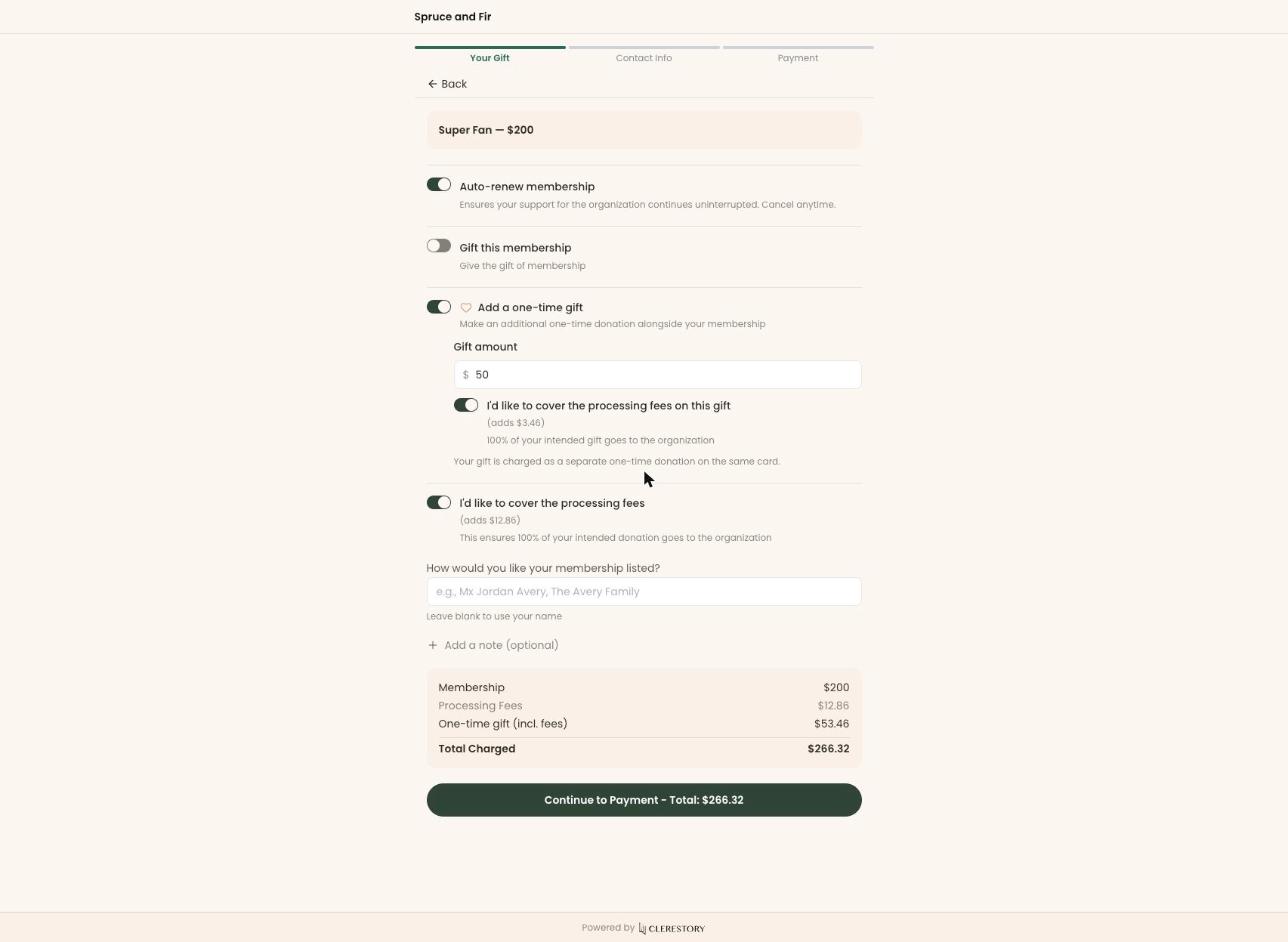
3% per transaction, and that is the whole of our price. No license fee, no per-seat pricing, no modules, no support tiers, no minimum and no contract. You never receive a bill from us, because the fee comes out at the time of the payment—and if you refund a gift, our 3% comes back with it.
Stripe processes the payment on your own Stripe account at 2.2% + $0.30 for customers with Stripe's non-profit rate, or 2.9% + $0.30 without it.
And your supporters can cover both fees, ours and Stripe's. Across every payment we processed through August 2026, our customers paid an effective 1.65% platform fee on our 3% once supporters had covered their share, and about 1.5% in Stripe processing.
A subscription can't be covered by your supporters. Our fee can.
That works because donors are offered the choice to cover both fees. The choice is theirs, and the box starts unticked—and across every payment through September 2026, 44% of people paying chose to cover them.
So what will it actually cost you?
The numbers worth comparing are what the software costs and what the card processing costs, each on its own line. Ask every vendor on this page for both, and ask which of them your supporters can cover.
Then notice how few of them can answer. Bloomerang publishes "starting at $242 a month" but no record count, so you cannot work out what you would actually pay. Blackbaud publishes no license price and no billing unit at all, so neither can they. Greater Giving publishes no figure for its annual software fee, its per-transaction service fee or its card processing, though its own help center confirms all three exist. Neon CRM publishes its software price and its module surcharges but not its card rate, so you can compute half of it. Funraise publishes its fee schedule in full, which is more than most manage, though the price of its Premium plans is still a conversation with sales. Little Green Light publishes its whole ladder and deserves credit for it—though a subscription is a fixed cost you carry in a lean year exactly as you do in a good one.
Ours are 3% and 2.2% + $0.30, and the working is above.
What none of them documents
We also checked the six platforms that publish pricing against a handful of things our own customers need, reading their public help centers and product pages rather than guessing. We state these carefully, because absence of documentation is not proof of absence—and in Neon's case most documentation sits behind a customer login, so we have credited them wherever we found anything at all.
- Sales tax on retail items. Five of the six do not document applying a tax rate to a merchandise sale. Zeffy says so outright: "Zeffy does not to currently automate taxes on your tickets." Neon CRM is the exception, through its TaxJar integration, which provides "real time sales tax calculations at checkout in the Neon CRM online store."
- Liability waivers captured at registration. Neon CRM documents an event waiver statement a registrant must agree to before completing registration. The other five do not document a native waiver field as a shipped feature. Zeffy is explicit: "While Zeffy doesn't have a specific function to add a waiver to your forms, we offer two different types of workarounds!" Funraise's only waiver mentions are release notes marked "In Progress".
- A correct tax receipt per legal entity. Several can route money to more than one bank account; none of the six documents issuing the right receipt for the right 501(c) entity on each payment.
Several things we expected to find missing were not missing, and it is worth saying so. Givebutter, Bloomerang, Funraise and Neon CRM all support physical card readers. Zeffy, Little Green Light, Bloomerang and Neon CRM all document inventory that decrements. Zeffy, Little Green Light and Neon CRM all support memberships with terms and renewals rather than only recurring gifts. If you have read elsewhere that these platforms cannot do those things, that is out of date.
How we checked
On 3 September 2026, on 4 September 2026 for Neon CRM, and on 29 September 2026 for Greater Giving, we fetched each vendor's own pricing page and help center and recorded verbatim what it says. Where a page did not exist we say so. Where a vendor publishes a price somewhere other than its pricing page—Bloomerang's processing rates, or Neon's payment fees in its NeonPay Terms of Service—we went and found it. Where a vendor documents its fee structure only in its help center, as Greater Giving does, we quote that.
Prices change and pages move, and every figure here is quoted as it stood on the date given. If anything is out of date or wrong, tell us and we will correct it.
Frequently asked questions
How much does non-profit CRM software cost?
It varies widely, and many vendors publish only part of the price. As of September 2026, Little Green Light published $45 to $135 a month by constituent count, Neon CRM started at $99 a month, Bloomerang's Giving Platform started at $242 a month billed annually, and Blackbaud and Greater Giving published no price at all. Clerestory charges 3% per transaction, with no license fee, no modules and no contract.
Is Zeffy really free for non-profits?
For the organization, yes: as of September 2026 Zeffy published no transaction fees and no platform fees. The cost lands on donors through an optional contribution that is set to a suggested amount by default, which donors can change to zero; Zeffy publishes an average contribution of roughly 4%.
How much does Givebutter cost?
As of September 2026, Givebutter's free tier charged 0% platform and processing fees with optional donor tips switched on, or a flat 3% platform fee plus standard processing with tips off. Givebutter Plus started at $29 a month billed annually, priced by contact count.
How much does Bloomerang cost?
As of September 2026, Bloomerang published starting prices of $242 a month billed annually for its Giving Platform and $125 a month for its CRM, but no record or contact count against those prices. Card processing on Bloomerang Fundraising was 3.95% + $0.30 for Visa, Mastercard and Discover.
How much do Blackbaud Raiser's Edge NXT and Altru cost?
Blackbaud publishes no price for Raiser's Edge NXT or Altru: no figure, range or starting price on its pricing or product pages as of September 2026. Blackbaud's own FAQ says it provides a personalized quote instead.
What does Clerestory cost?
Clerestory's platform fee is 3% per transaction, and Stripe processes each payment on the organization's own Stripe account at 2.2% + $0.30. Supporters can choose to cover both fees at checkout, and across every payment through August 2026, Clerestory customers paid an effective 1.65% platform fee once supporters had covered their share.