


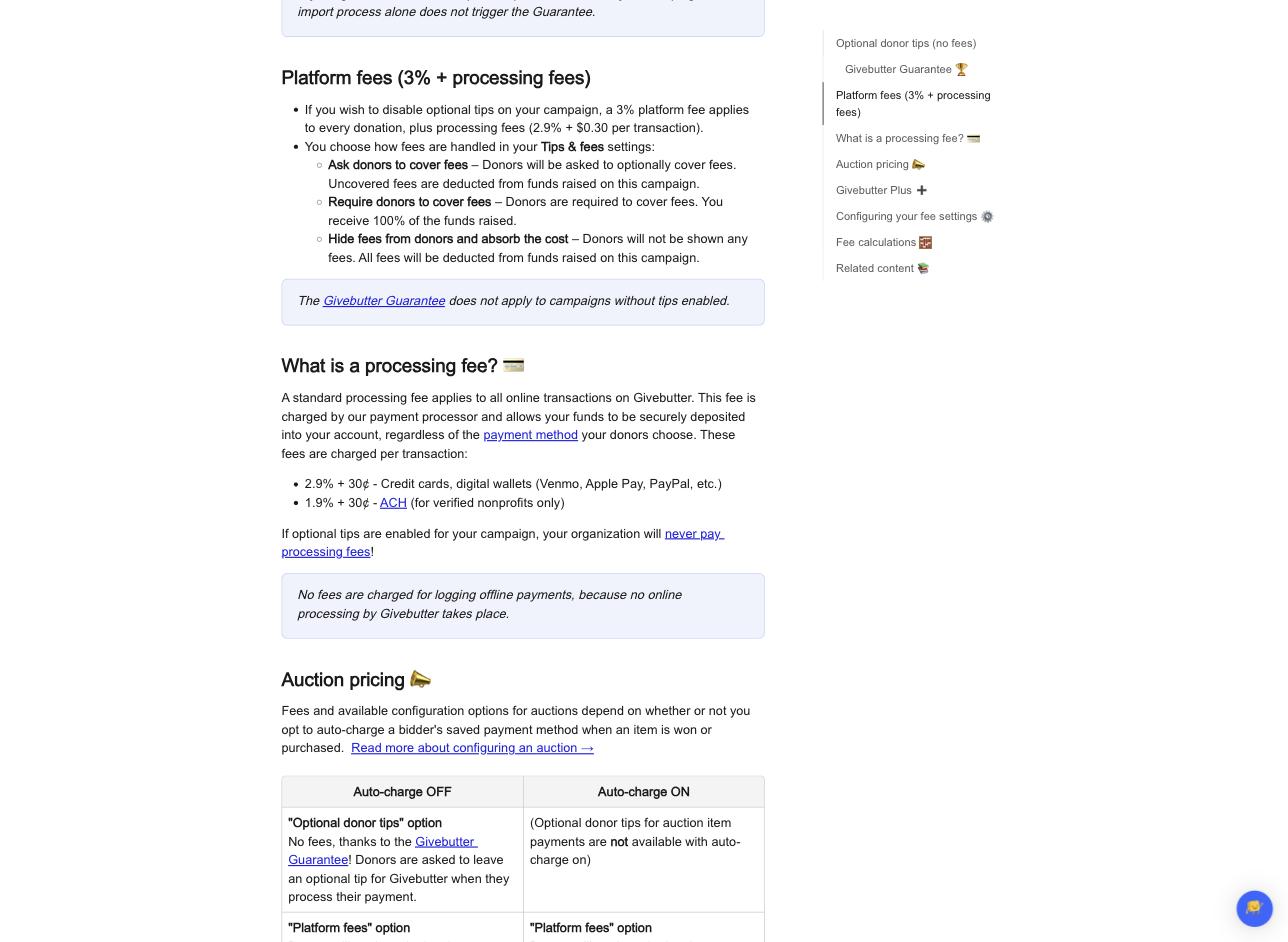
Givebutter: the platform fees section of Givebutter's own help center, read on 3 September 2026, showing the 3% fee that applies when optional donor tips are disabled.
Most comparison pages are written by the company that wants to win, which is why almost none of them are useful. This one is too, so here is how we have tried to make it worth reading: every claim about Givebutter below is quoted from Givebutter's own help center, with the date we read it, and where Givebutter matches us we say so plainly rather than leaving the row out.
Every screenshot on this page is labeled with whose product it shows.
Two prices, and the organization chooses which one it pays.
With optional donor tips enabled, the platform fee is zero, and Givebutter goes further than that. Their own words: "Keep optional tips enabled, and your organization pays $0 in fees. Processing fees (2.9% + $0.30 per transaction) are shown to donors but are always optional. If donors don't cover processing fees, Givebutter covers them."
That last sentence deserves to be read twice. It means an organization on the tipping model can genuinely receive 100% of a gift with no processing deduction at all. We are not aware of a more generous published position on this list, and we are not going to be coy about it.
With tips disabled, a platform fee applies: "If you wish to disable optional tips on your campaign, a 3% platform fee applies to every donation, plus processing fees (2.9% + $0.30 per transaction)."
There is also a paid tier, Givebutter Plus, priced by contact count from "$29 / month" up to "Custom" above 10,000 contacts. Givebutter is clear that it changes no fees: "No – tips and platform fees remain the same for both Givebutter and Givebutter Plus users."
3% per transaction, and that is the whole of our price. No license fee, no per-seat pricing, no modules, no support tiers, no minimum and no contract. Stripe processes the payment on your own Stripe account at 2.2% + $0.30, the non-profit rate our customers receive.
Supporters can cover both fees at checkout, ours and Stripe's. Across every payment we processed through August 2026, our customers paid an effective 1.65% platform fee on our 3% once supporters had covered their share, and about 1.5% in Stripe processing.
And 3% is a ceiling, not a floor. Our published Terms of Service say it plainly: "At higher processing volumes, the platform fee may be adjusted or capped at a mutually agreed rate."
Givebutter with tips switched off is a 3% platform fee plus processing. So is Clerestory. The platform fee is genuinely the same number, and we are not going to pretend otherwise or bury it below the fold.
The processing leg is not the same. Givebutter publishes 2.9% + $0.30. Our customers process on their own Stripe account at 2.2% + $0.30, the non-profit rate. Same platform fee, roughly seven tenths of a percentage point apart on the card.
And that is the distinction worth carrying into every vendor conversation, not just this one: a published processing rate is not a price. It is what the card costs. What the software costs sits on top of it, and most vendors in this market quote the two separately, or quote the card rate and decline to publish the software at all. So ask every platform you evaluate for both numbers, each on its own line, and count how many can give you both. Ours are 3% and 2.2% + $0.30.
To Givebutter's credit, they are one of the few who could. Which is why the real question here is not the price at all.
If you want your donors asked to tip the software company, Givebutter is cheaper than us, straightforwardly and by design, and it absorbs the processing fee when donors decline. If you would rather that ask did not appear in your checkout, Givebutter's own answer is a 3% platform fee plus a card rate higher than ours.
Either way, what the 3% buys is the thing to compare. That is what the table is for.
Read the right-hand column carefully. "Not documented" does not mean Givebutter cannot do it. It means we searched Givebutter's published documentation for it on 3 September 2026 and did not find it. If it exists and we missed it, tell us and we will correct this page.
| Capability | Clerestory | Givebutter |
|---|---|---|
| Price published on the vendor's own website | Yes, 3% per transaction | Yes, $0 with tips on and 3% with tips off |
| Walk-up point of sale | Yes | Yes—"All mobile app users can sell tickets directly from the mobile app" |
| Card readers and in-person hardware | Yes | Yes—"The Givebutter app is only compatible with the Stripe M2 card reader." at "$99 each" |
| Donor or member option to cover processing fees | Yes | Yes, with three modes: ask, require, or absorb |
| Memberships as a product with a term and expiry | Yes | Not documented as a product—"Use a simple Form campaign to create an embeddable membership signup page with customized giving levels" |
| Timed-entry admission | Partly—walk-up admission is sold by price tier, not by time slot; timed sessions with a capacity can be sold as an event series of dated sessions | Not documented—capacity is event-wide, and the published ticket fields carry no time |
| Sales tax on retail items | Yes | No—"Givebutter currently doesn’t support auto-calculating or adding sales tax to auction items." |
| Online store or gift shop | Yes | Not documented—there are three campaign types, Form, Page and Event, and none is a store |
| Retail inventory reduced automatically by a sale | Yes | Auction items only—"As bidders purchase this item, the quantity will decrease until it is sold out." |
| Self-service kiosk | Yes | Not documented |
| Liability waiver captured at registration | Yes—versioned, required before payment, with signer, timestamp, IP and version hash recorded | A required custom checkbox is possible; no waiver document, versioning or signature capture is documented |
| Correct tax receipt per 501(c) entity, per transaction | Yes | Not documented—"Receipts sent to donors always include your EIN." singular, set once at account level |
| Process on your own Stripe account | Yes | No—"You cannot link an existing Stripe account to Givebutter. You will need to create a new Stripe account specifically for use with Givebutter." |
| Silent auction with bidding from the guest's own phone | Yes—max bids, buy-now and outbid alerts by email | Yes |
| Live auction and paddle raise recorded by bidder number | Yes—the auctioneer screen shows the winner's name as the number is typed | Yes—printable bidder number cards, and a paddle raise at a ticketed event |
| Winners charged in one batch from cards saved at purchase or check-in | Yes—plus a pay link for anyone left owing | Yes—winning bids charged automatically to the card on file |
| Auction receipts showing fair market value and the deductible amount | Yes | Yes—when a fair market value is entered on the item |
| Raffle tickets sold online and at a table | Yes—singles or bundles, such as 10 for $40 | Partly—sold online as event tickets; a table sale for raffles is not documented |
| Random raffle draw inside the product, with every draw recorded | Yes—a cryptographically random pick, and refunded tickets cannot win | Not in the product—Givebutter recommends its separate random number generator |
| Raffle money kept out of giving history and never receipted as deductible | Yes | Not documented |
| Move a payment between a membership and a donation, with a corrected receipt | Yes | Partly—a transaction can move to another campaign, but not one tied to a ticket or an auction item |
| Membership grace period, and a longer first term or lower first price for late joiners | Yes | Not documented |
| Offer codes on event tickets | Yes—percent off, amount off or a fixed price, with caps and date windows | Yes—a percentage or a fixed amount, limited to chosen tickets |
| Member pricing applied automatically at event checkout | Yes | Not documented |
Clerestory does twenty-three of the twenty-four in full and timed entry in part. Givebutter matches us on nine of them, and we have left those nine in plainly, because a comparison that finds the competitor lacking on everything is one nobody should trust.
Givebutter documents exactly three things you can build: a Form, a Page and an Event. That is a clean, deliberate product and it covers online fundraising well.
What it does not contain is a place to sell things. There is no store campaign type, no catalog, no merchandise record. The nearest mechanism is a fixed-price "Buy Now" listing inside an auction, which decrements as it sells—a real capability, but one that lives inside an auction event rather than being open on your website in March when someone wants a book.
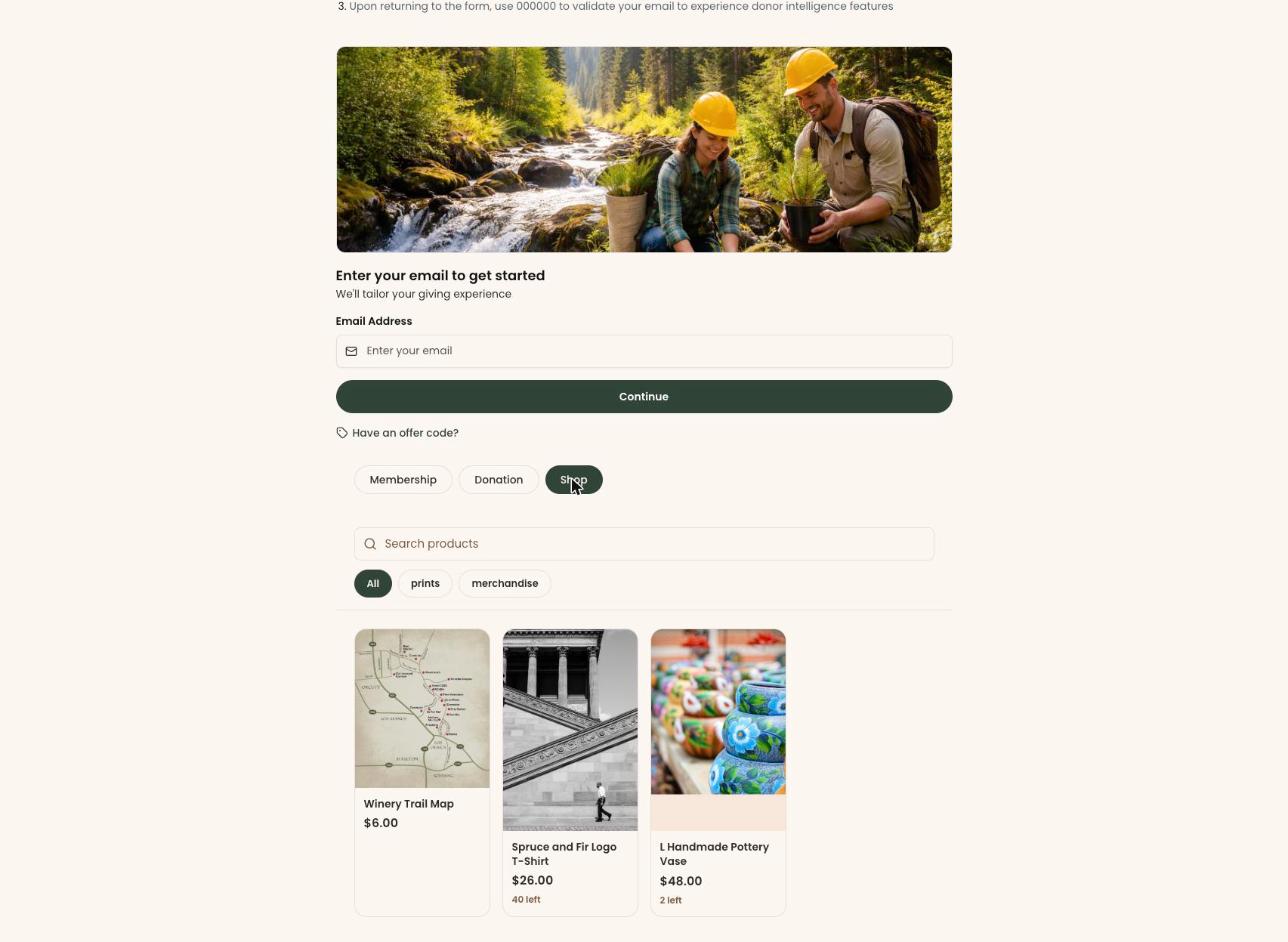
Givebutter's own membership guidance is to build one out of parts you already have: "Use a simple Form campaign to create an embeddable membership signup page with customized giving levels." and "You can also add memberships (in the form of recurring plans) to any fundraising campaign."
That works, and for an organization whose membership is simply a recurring gift, it works well. What it does not give you is a membership with a term. We could find no documentation of a fixed shared expiry date, a rolling term from the purchase date, a lapsed state, or an anniversary. If a membership is a recurring plan, then it lasts exactly as long as the card keeps working, which is a different thing from a year of benefits that expires and has to be renewed.
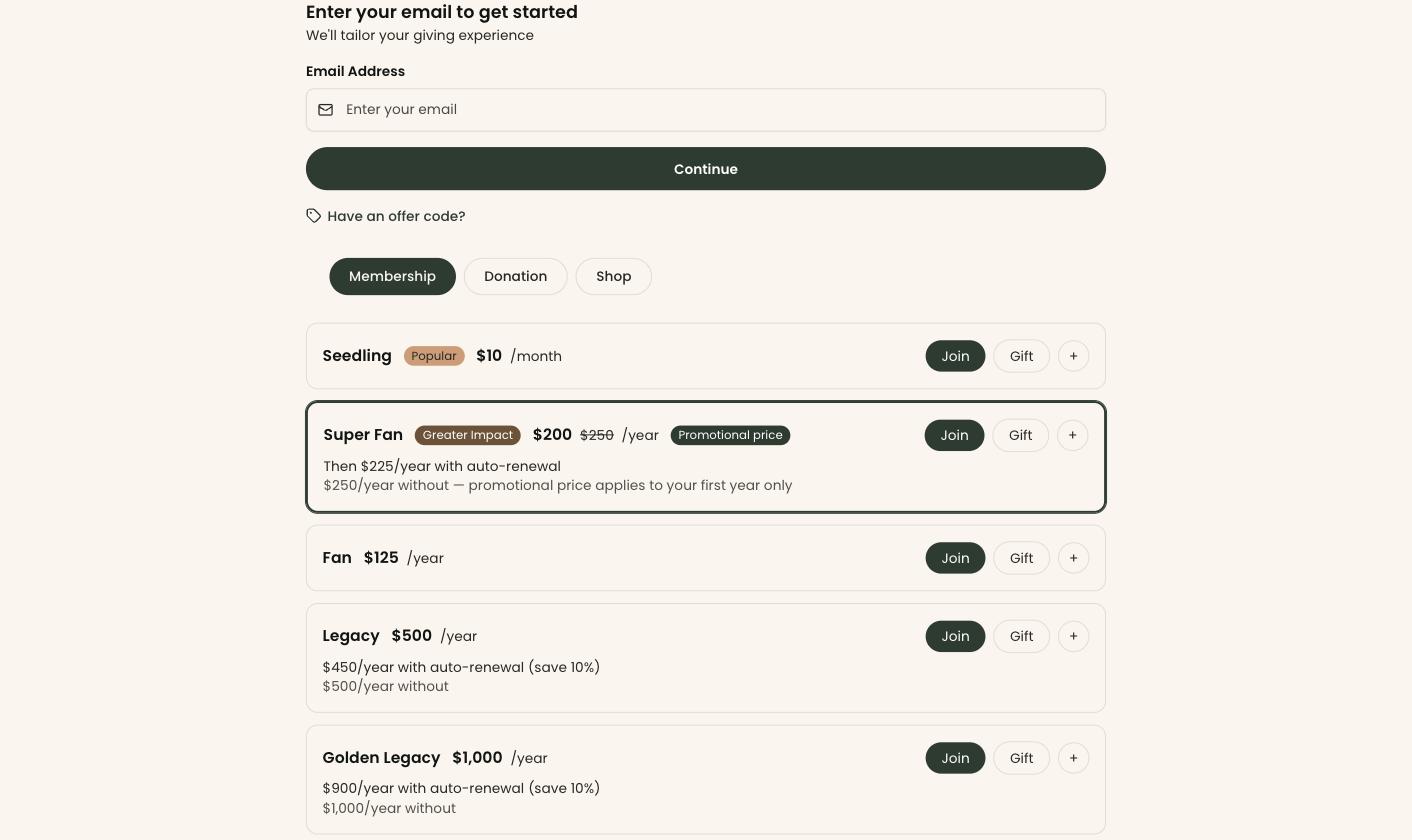
This is the Clerestory kiosk mid-transaction. Five of the rows above are visible in one screen.

Admission, retail and a donation in the same cart, against the same member record, with sales tax calculated. Givebutter has the reader and the fee toggle; it is the admission, the shop and the tax that are not there.
Givebutter is explicit: "You cannot link an existing Stripe account to Givebutter. You will need to create a new Stripe account specifically for use with Givebutter."
In Clerestory, payments are processed on your own Stripe account. Your organization is the merchant of record, the payout schedule is yours, the dispute history is yours, and if you ever leave us the account and its history stay with you. It is also why our customers pay 2.2% + $0.30 rather than a rate set by us: the relationship with the processor is theirs, not ours to mark up.
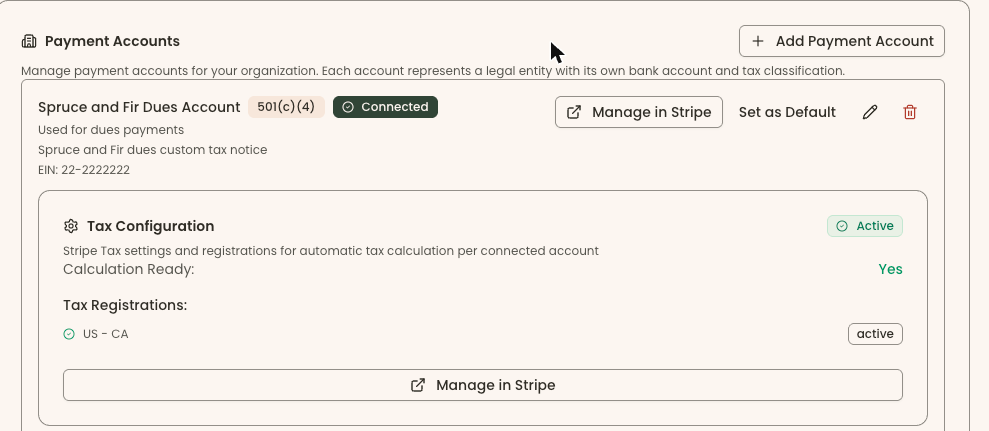
Givebutter's receipting is account-level: "Receipts sent to donors always include your EIN." One EIN, one account. Chapters exist as linked parent and child accounts, enabled case by case, and nothing in the documentation describes each entity issuing receipts under its own EIN.
In Clerestory each entity is a payment account. Its own EIN, its own tax classification, its own bank account, and its own tax notice on the receipt. Every campaign routes revenue to the account you choose, so the gift lands against the right entity and the receipt carries the right EIN at the moment it is sent.
Givebutter runs a real auction: bidding from a phone, printable bidder number cards, a paddle raise at a ticketed event, winning bids charged to the card on file, and receipts that subtract fair market value. Raffles are sold as event tickets, and for the draw Givebutter recommends its random number generator, a separate tool on its website rather than a step inside the campaign. We could not find how a raffle ticket is receipted.
Auctions and raffles are now part of Clerestory, in the same account as memberships, admission and the gift shop. Guests bid on silent items from their own phones, with max bids, buy-now and outbid alerts by email. The auctioneer records live items and paddle-raise levels by bidder number, and a big screen in the room shows the running total and the countdown to each close. After the event every saved card is charged in one batch, with a pay link for anyone left owing. Each guest's statement separates fair market value from the deductible amount, and a paddle-raise gift lands in the donor's giving history as a gift.
Raffles run on their own or inside an event, sold online or at a table. A numbered raffle is drawn inside Clerestory with a cryptographically random pick, and every press of the button is recorded, so a re-draw is visible rather than silent. Raffle money counts as money raised, never as giving, and it is never receipted as deductible.
Memberships and events moved too. Membership rules now cover a shared membership year or a rolling one, a grace period, an early-renewal window, and a longer first term or a lower first price for late joiners. A payment recorded against the wrong thing—a membership paid through the donation form, say—can be moved between membership and donation after the fact without charging anyone again, and the donor receives a corrected receipt that replaces the earlier one. Event offer codes give percent off, an amount off or a fixed price, capped and dated, and signed-in members get member pricing automatically.
Givebutter is a genuinely good fundraising platform and its tipping model is more generous than most, because it absorbs processing fees rather than passing them to you. On nine of the twenty-four rows above it does exactly what we do, and on price it can be free where we cannot.
If your organization's income is donations, peer-to-peer campaigns, an annual gala and an auction, Givebutter is built for that shape and a lot of what we do is work you do not need.
The evaluation changes when the institution has a door, a shop and a calendar. A gift shop that is open in March, sales tax on a mug, a waiver a parent signs before a child's class, and two EINs on two sets of receipts are all things we could not find documented on Givebutter's side. If three or more of those describe your week, you are comparing a fundraising platform to an operations platform, and price is the least interesting difference between them.
If you are large enough that a percentage of everything makes you uneasy, say so early. Our terms already provide for the platform fee to be adjusted or capped at a mutually agreed rate at higher processing volumes, documented in writing between us and published where you can read it before you ever speak to us.
On 3 September 2026 we read Givebutter's own help center and pricing page, and verified every quote above against the live pages in a browser rather than trusting an automated fetch. We did not use G2, Capterra, or any comparison site, and we did not treat marketing pages as evidence of what the software does.
On 29 September 2026 we added eleven rows—auctions, raffles, membership rules, moving a payment and event offer codes—and checked each against Givebutter's own help center on that date. Where a cell quotes Givebutter, the quote is from Givebutter's own page.
Two things we deliberately did not claim, because Givebutter does not publish them: the default suggested tip percentage, and whether the tip is preselected. A 10% figure appears in their documentation explicitly as an example, not a default, so we have not repeated it as one.
Corrected 30 September 2026: Clerestory sells admission by price tier, not by time slot; timed sessions can be sold as an event series.
Screenshots labeled Clerestory are from a Clerestory demo organization with test data. Screenshots labeled Givebutter are from Givebutter's own help center. Every quote is reproduced as it stood on 3 September 2026. Documentation moves and products change. If anything here is out of date or wrong, tell us and we will correct it.
Clerestory is an alternative to Givebutter for non-profits that sell admission, gift shop items with sales tax and memberships with a term, not just donations and events. As of 3 September 2026, Givebutter documents three campaign types, Form, Page and Event, and none of them is a store.
Not if the organization keeps Givebutter's optional donor tips on: then Givebutter charges the organization $0 and covers processing when donors do not. With tips off, Givebutter charges a 3% platform fee plus 2.9% + $0.30 processing as of 3 September 2026, while Clerestory charges the same 3% with Stripe processing at 2.2% + $0.30.
Only with tips switched off. As of 3 September 2026, Givebutter charges no platform fee when optional donor tips are enabled, and a 3% platform fee on every donation plus 2.9% + $0.30 processing when tips are disabled. Givebutter Plus, from $29 per month, does not change those fees.
No. As of 3 September 2026, Givebutter's help center says an existing Stripe account cannot be linked, and a new Stripe account must be created for use with Givebutter. Clerestory processes payments on the organization's own Stripe account, so the payout schedule and dispute history stay with the organization.
Givebutter can be free to the organization: with optional donor tips on, it charges no platform fee and covers the processing fee when a donor declines to, so an organization can receive 100% of a gift. Clerestory always charges 3% per transaction plus Stripe processing.