


A raffle is one of the simplest ways to raise money, and one of the easiest to get wrong. Cash goes missing between the table and the deposit. Ticket stubs get double-counted. Somebody asks, afterwards, whether the draw was fair. And a raffle ticket is not a donation, so it must never be receipted as one. We built raffles around those problems.
Two kinds of raffle
When you create a raffle, you choose how tickets are issued.
- Numbered tickets. Every sale, at the table and online, gets ticket numbers from one pool, and you run the drawing inside Clerestory. You can start the numbering above your pre-printed ticket books so the two never collide.
- Paper tickets. Clerestory records every sale and every payment, and you draw from the drum as you always have.
Singles and bundles
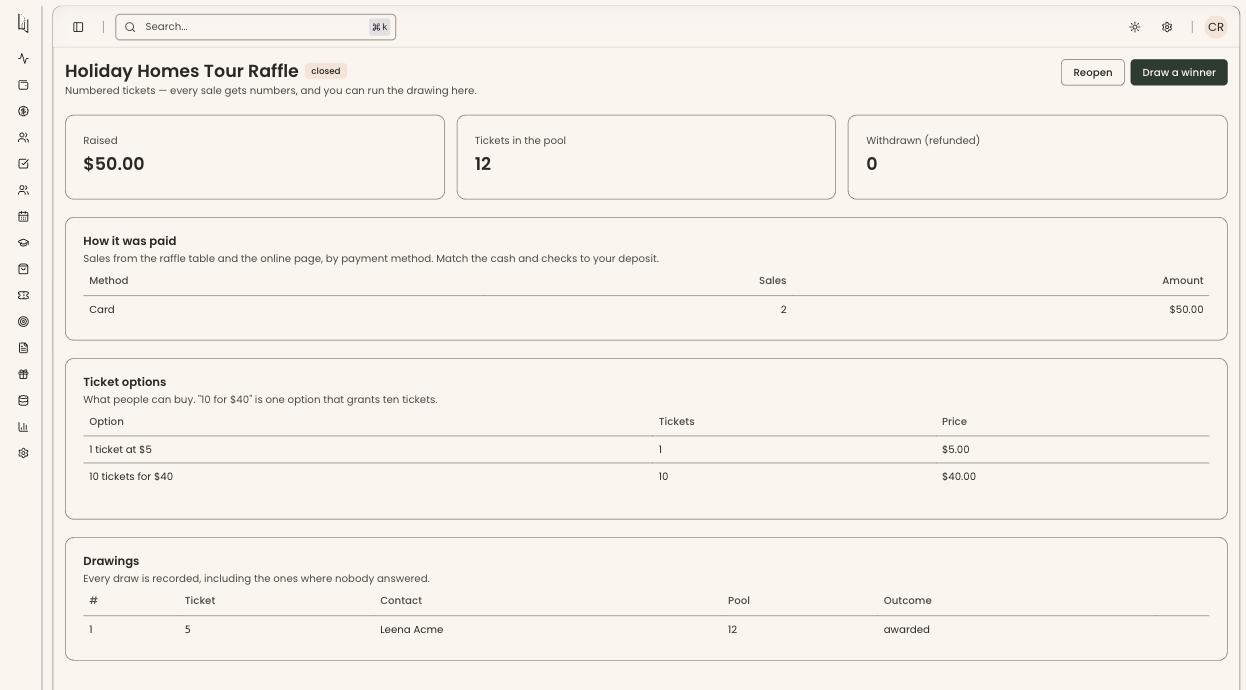
A ticket option is simply a price for a number of tickets, so "1 ticket at $5" and "10 tickets for $40" sit side by side. The price and count are saved with each sale, so changing an option later never changes what someone already bought.
Selling online
Every raffle has its own online page to share with supporters or put on your website. Buyers pick their tickets, enter their email and pay by card. With a numbered raffle, their ticket numbers arrive by email.
Selling at the table
Open the table screen on a tablet or laptop at the raffle table. You do not need a card reader. There are five ways to take payment:
- Card reader: tap, insert or swipe.
- Type the card in.
- Pay on phone: the buyer scans a QR code and pays on their own phone.
- Cash.
- Check, with the check number recorded.
Cash and check sales need the kiosk PIN or a signed-in staff member, so every one is accounted for. The buyer's email is optional at the table, for the moments when the line is long.
Raffle tickets are also a lane on the kiosk, so one card payment can cover raffle tickets, admission and a donation together.
Matching the money to the deposit
Each raffle's page shows what it raised, how many tickets are in the pool and anything withdrawn by a refund. How it was paid breaks sales down by payment method, with every check listed, so the cash box and the bank deposit can be reconciled against the same numbers.
A draw you can stand behind
When entries close, Draw a winner picks a ticket with a cryptographically random choice. Tickets that were refunded, including refunds still in progress, are never in the pool, and a ticket that has already won is not drawn again.
Every press of the button is recorded before anyone sees the result: which draw it was, who pressed it, how many tickets were in the pool and what happened. A re-draw adds a new record rather than replacing the old one, so if the first winner cannot be reached, everyone can see that there was a second draw and why. If the winner bought with an email address, they are told by email.
Not a donation, never a receipt
A raffle ticket buys a chance to win, so it is not tax-deductible, and Clerestory treats it that way. Raffle money counts toward what you raised and has its own line in your revenue reporting, but it never counts as giving, and the ticket email is never a tax receipt. Buyers who give their email become contacts in Clerestory like anyone else, with their raffle purchases kept separate from their giving.
A refund voids every ticket on that purchase, so a refunded ticket can never win.
What it does not do
Raffle tickets cannot be given away free. Each raffle has one prize description, and multiple winners are drawn as multiple draws. There are no text-message notifications. And raffle law varies from state to state, so check the rules that apply to you before you sell. Clerestory does not check them for you.
What it costs
Nothing extra. Raffles are part of every Clerestory account at the same 3% per transaction as everything else.
Frequently asked questions
How can a non-profit sell raffle tickets online and at the event?
Clerestory gives every raffle its own online page where buyers pay by card, a table screen for a tablet or laptop at the raffle table, and a lane on the kiosk, so one card payment can cover raffle tickets, admission and a donation together. Tickets can be sold as singles or bundles, such as 10 for $40.
Do I need a card reader to sell raffle tickets at a table?
No. The Clerestory raffle table screen takes payment by card reader, by typing the card in, by the buyer paying on their own phone from a QR code, by cash, or by check with the check number recorded.
How do you run a fair raffle drawing?
In a numbered Clerestory raffle, Draw a winner picks a ticket with a cryptographically random choice, and refunded tickets and tickets that have already won are never in the pool. Every draw is recorded before anyone sees the result, and a re-draw adds a new record rather than replacing the old one.
Are raffle tickets tax-deductible?
No. A raffle ticket buys a chance to win, so it is not tax-deductible. Clerestory never sends a tax receipt for a raffle ticket and keeps raffle money out of giving, with its own line in revenue reporting.
Does Clerestory check state raffle laws?
No. Raffle law varies from state to state, and Clerestory does not check it for you, so check the rules that apply to your organization before you sell.
How much does it cost to run a raffle in Clerestory?
Nothing extra. Raffles are part of every Clerestory account at the same 3% per transaction as everything else, with no license fee and no contract.