


This page is written by Clerestory, which makes it one of two things: a sales page, or a useful one. We have tried for the second. Every claim about DACdb below links to the page on dacdb.com it came from, read on 30 September 2026, and where DACdb does something we do not, we say so first rather than last.
Every screenshot on this page is from Clerestory.
What is DACdb, and who is it built for?
DACdb describes itself as "Your Premium Rotary Software Database System", in use "Since 2003" (DACdb brochure). It is built around the Rotary district: its Quick Start Guide describes clubs that "submit monthly attendance reports to your district through DACdb" (DACdb Quick Start Guide). Members log in to their club's database and can search their own club or every club in the district (DACdb help file).
That district structure is what DACdb does best, and it connects to Rotary International too. When a club adds a member, "Rotary International receives an automatic message to add the new member", and connecting the two "will allow you to upload and sync data easily between the two databases" (DACdb Quick Start Guide). Around that sit meeting attendance, committee management, email and text messaging, event registration, "over 75 different reports", and premium modules for attendance, dues and accounting, and District Grants (DACdb brochure).
What to look for in Rotary club management software
Whichever you choose, these are the questions that separate one system from another for a Rotary, Kiwanis or Lions club:
- What does your district need from the club, and through which system? If your district expects attendance, officers or membership changes through a particular system, that requirement decides more than any feature list.
- Can the treasurer see dues at a glance? Billed against collected, who has paid, who is overdue and whose card failed, without building a spreadsheet.
- Are the club and the foundation kept apart? Most clubs are a 501(c)(4) or 501(c)(7) with a 501(c)(3) foundation beside it. Dues should never be receipted as deductible, and foundation gifts should be.
- Who processes the card, and what does it cost? Ask for the all-in cost per dollar: software, platform fee and card processing together.
- Do the fundraisers live in the same place as the members? The crab feed, the golf tournament, the raffle and the gala are where most club money comes from.
What does DACdb cost?
As of September 2026, we could not find a published price on dacdb.com. DACdb's brochure describes attendance, dues and accounting as premium modules, offers a "FREE 30-day trial", and says monthly club attendance tracking comes at "no cost with your subscription" (DACdb brochure). The WordPress website plugin says "A subscription for the plugin is required for all users" (DACdb Plus guide).
Card payments are separate from the subscription. DACdb invoices members, and members pay by card "if your club has a credit card payment gateway setup with DACdb" (DACdb finance guide). The gateway's processing rate is set by the gateway vendor, and we did not find it on dacdb.com, so ask your district and your gateway for both numbers.
What does Clerestory cost?
3% per successful transaction, on the club's own Stripe account, plus Stripe's processing. No license fee, no per-seat pricing, no modules, no minimum and no contract. Members and donors can choose to cover the fees at checkout, and if a payment is refunded, our 3% comes back with it. Across every payment we processed through August 2026, our customers' all-in cost, software and card processing together, was 3.148%.
Because Clerestory charges only when money moves, a club that keeps DACdb for the district is not paying twice for a subscription. It pays DACdb for district administration and pays us only on the dues, gifts and tickets we process.
Clerestory vs DACdb, feature by feature
"Not documented" does not mean DACdb cannot do it. It means we looked for it on dacdb.com on 30 September 2026 and did not find it. Several of the DACdb documents we read are older than that, and we have dated each one. If something here is wrong, tell us and we will correct it.
| Capability | Clerestory | DACdb |
|---|---|---|
| Club member database and profiles | Yes | Yes—member profiles members can edit themselves (brochure, help file) |
| One database across every club in a district | No | Yes—members search their own club or every club in the district (help file) |
| Member data sent to Rotary International | No | Yes—"Rotary International receives an automatic message to add the new member, eliminating the need for you to enter the data twice!" (Quick Start Guide) |
| Meeting attendance | No | Yes—online, offline, phone, tablet or barcode entry, "Over 10 different attendance reports", and monthly attendance reports submitted to the district (brochure, Quick Start Guide) |
| District Grants applications | No | Yes, as a premium module for the internal District Grants application process (brochure) |
| Committees | No | Yes—a committee management module (brochure) |
| Text messages to members | No | Yes, called PText (brochure) |
| Club website | No—forms, event pages and a directory you embed or link to | Yes—news items published to your website, and a WordPress plugin that needs its own subscription (brochure, DACdb Plus guide, April 2022) |
| Dues invoices by tier, with proration for mid-year joiners | Yes | Invoicing, yes—"Generate and send detailed invoices to members, track payments and collect payments online" (brochure); proration not documented |
| Members pay dues automatically | Yes | Not documented |
| Online card payments | Yes—on the club's own Stripe account | Yes—through a payment gateway the club sets up, from "seven different payment gateway vendors" (brochure, finance guide) |
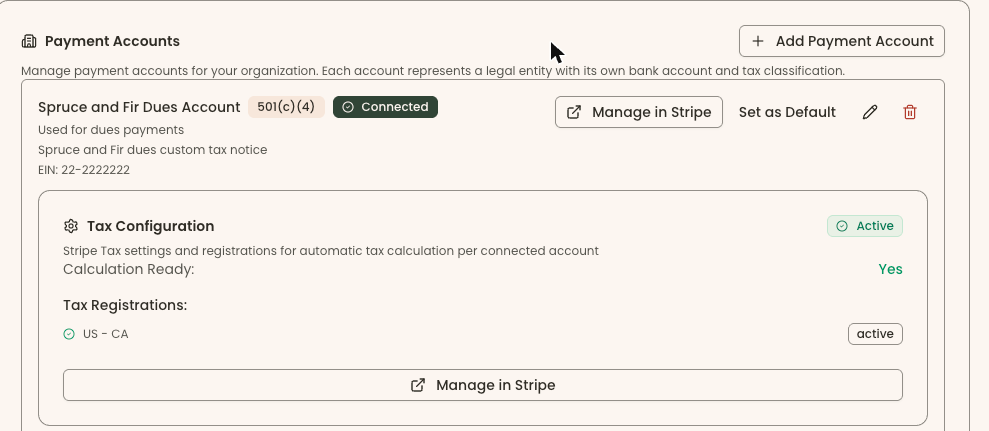
| Club and foundation kept apart | Yes—each its own payment account, bank account, EIN and tax classification | Not documented |
| Receipt wording set by which entity was paid | Yes | Not documented |
| Year-end giving summary, $0 deductible for club payments | Yes | Not documented |
| QuickBooks | Yes—connects to QuickBooks Online | Yes—"QuickBook integration for easy exports" (brochure) |
| Event registration | Yes—tickets with offer codes, presales and add-ons | Yes—online registration with custom forms (brochure) |
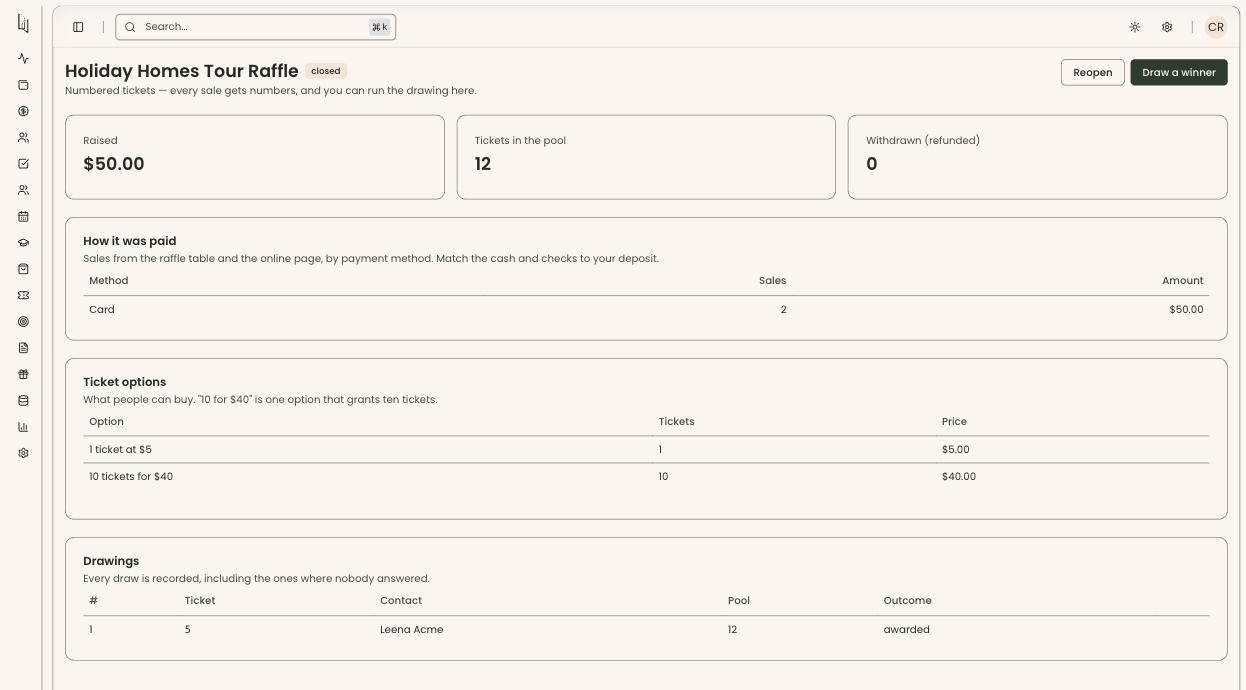
| Raffle tickets online and at the table, with the drawing recorded | Yes | Not documented |
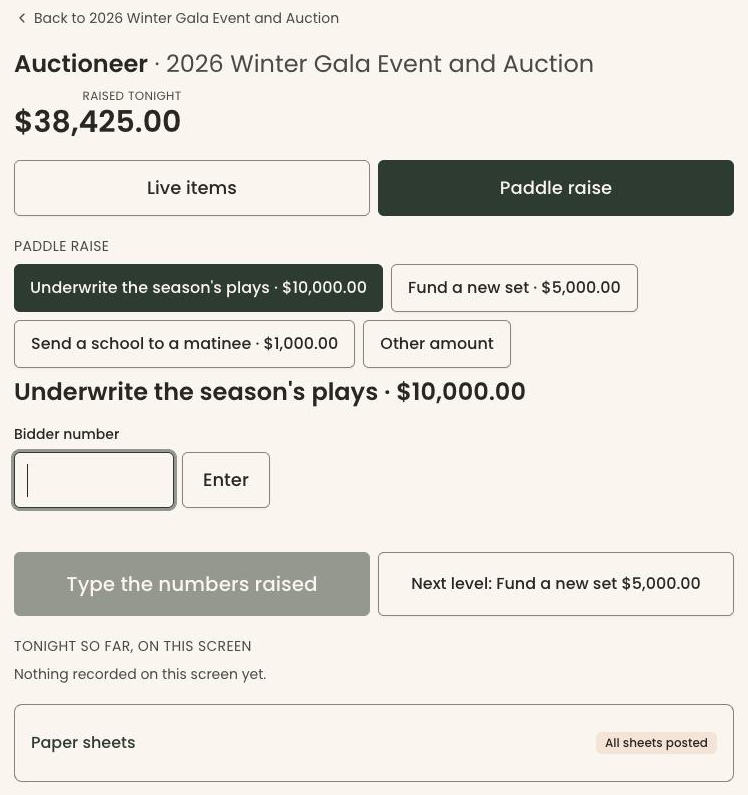
| Silent auction from guests' phones, live auction and paddle raise by bidder number | Yes | Not documented |
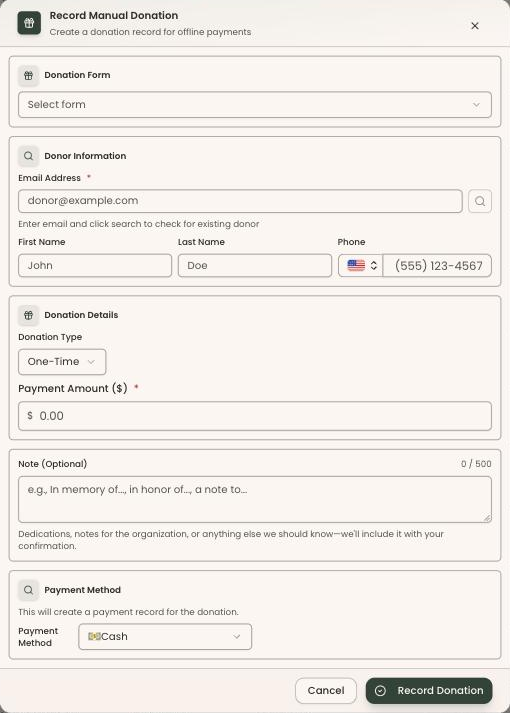
| Cash and check payments counted in every report | Yes | Payments tracked against invoices (brochure) |
Everything in the top half of that table, the part that makes DACdb a Rotary system, Clerestory does not do. The bottom half, money, receipts and fundraisers, is where Clerestory goes further.
What Clerestory does not do
- Meeting attendance. Clerestory does not track who attended the weekly meeting.
- District reporting and Rotary International. Clerestory has no district level, does not roll club data up to a district, and does not send member or officer data to Rotary International.
- District Grants, RYLA and RLI. There is no grants application workflow and nothing built specifically for RYLA or RLI, though a youth camp can be run as a class with applications and age limits.
- Committees, service hours and text messages. Clerestory does not manage committees, log volunteer hours or send texts.
- Club websites. Clerestory gives you forms, event pages and a member directory to embed or link to, not a website builder.
Keep DACdb for the district, move the money to Clerestory
For many Rotary clubs this is the honest answer. If your district runs on DACdb and expects attendance, officer changes and membership data through it, keep that task there. It is what DACdb was built for.
Then move everything that involves money: dues, foundation gifts, event tickets, raffles and the gala. The member stays in DACdb for the district, and pays in Clerestory. The treasurer gets one place to see what was billed, what came in and what each receipt said.
Dues the treasurer can see at a glance
Set dues by tier, billed every month, quarter, half-year or year, with the billing month you choose and proration for members who join mid-year. Each billing period shows how much has been collected against how much was billed, who has paid, who is due, who is overdue and whose card did not go through. Mark honorary members so they are not billed, record a check when the treasurer hands you one, and export who owes before the board meeting. Members can pay automatically, so dues stop being something the treasurer chases.
The club and the foundation, each with the right receipt
In Clerestory, the club and its foundation are each a payment account on the same organization, with its own bank account, its own EIN and its own tax classification. Dues go to the club. Gifts go to the foundation. A gift to the foundation is receipted as tax-deductible to the extent allowed by law, and a payment to the club says it is not deductible as a charitable contribution. At year end, the Year-End Giving Summary shows each donor's total across every account, with $0 deductible for payments to a non-501(c)(3) account.
Every fundraiser on the club calendar
Sell tickets to the crab feed or the golf tournament, with offer codes, presales and add-ons. Sell raffle tickets online and at the table, and record the drawing so there is a record of how the winner was chosen. At the gala, guests bid on silent items from their phones, the auctioneer records the live auction and the paddle raise by bidder number, and every winner is charged in one batch.
Cash and checks, too
Record a cash or check gift, pledge or dues payment against the member's record, and it counts in every report alongside card payments. If the club keeps its books in QuickBooks Online, Clerestory connects to it directly.
Which is the better fit for your club?
If your district runs on DACdb, choose DACdb for what the district needs: attendance, officers, Rotary International and District Grants. Nothing on this page is a reason to leave it for those tasks, and Clerestory would not replace them.
If the club's pain is money, that is where Clerestory fits: dues nobody has to chase, a foundation whose receipts are right the first time, and fundraisers that run from the same member records. Ask both of us the same question: what is the all-in cost per dollar the club collects? Ours is 3.148%, and the working is above. For more on how Clerestory works for clubs, see Clerestory for service clubs, or book a demo and bring your dues list.
How we checked
On 30 September 2026 we read DACdb's own documents on dacdb.com: the DACdb brochure (undated), the DACdb Quick Start Guide (undated), the DACdb Plus WordPress plugin guide (April 2022), the Finance module invoicing guide and the New Member Quick Start Guide. We did not use review sites or comparison sites. DACdb's home page did not return readable content to us, and we found no published price, so we have not stated one. If anything here is out of date, tell us and we will correct it.
Frequently asked questions
What is a good DACdb alternative for a Rotary club?
It depends on the job. For the club's money, Clerestory handles dues, foundation gifts, tickets, raffles and auctions, with the right receipt for the club and the foundation, at 3% per transaction plus Stripe's processing. Clerestory does not track meeting attendance or report to the district or Rotary International, so a club whose district uses DACdb for those should keep that task in DACdb.
Can a Rotary club use DACdb and Clerestory together?
Yes. A club can keep DACdb for attendance, officer changes and district reporting, and move dues, foundation gifts, tickets, raffles and auctions to Clerestory. Clerestory charges only on payments it processes, with no subscription, so the club is not paying for two licenses.
Does Clerestory report to Rotary International or the district?
No. Clerestory has no district level and does not send member or officer data to Rotary International. As of September 2026, DACdb's Quick Start Guide on dacdb.com says Rotary International receives an automatic message when a club adds a new member in DACdb, and that DACdb and Rotary International can sync data.
How much does DACdb cost?
As of September 2026 we found no published price on dacdb.com. DACdb's brochure describes attendance, dues and accounting as premium modules and offers a free 30-day trial. Card payments go through a payment gateway the club sets up, at the gateway's own rate.
Can a Rotary club collect dues online with Clerestory?
Yes. Clerestory sets dues by tier with the billing month the club chooses and proration for members who join mid-year, and members can pay automatically. Each billing period shows how much was collected against how much was billed, who has paid, who is overdue and whose card did not go through.
How much does Clerestory cost a Rotary club?
Clerestory charges 3% per successful transaction on the club's own Stripe account, plus Stripe's processing. There is no license fee, no per-seat fee, no minimum and no contract, members and donors can choose to cover the fees at checkout, and if a payment is refunded the 3% comes back.