

I started building Clerestory, PineconeAI as it was known then, in October of 2025 with a singular goal in mind: making payments surprisingly easy for non-profits.
Why this goal? I’ve lived through the pain first-hand of disconnected donors and payment records. I’m a current and former non-profit board member, I’ve customized software for non-profits (shout out to all my Salesforce non-profit starter pack folks), I’ve donated products, I’ve volunteered my time, and I’ve given financial support. In my over two decades of being of service to non-profits I’ve lived through the front-of-house donor and the back-of-house staff experience—and I’ve always been left wanting. So, I got to work building.
Beta testing began in January 2026 and the product worked! I marketed it as being a companion to your CRM where the CRM controlled the context and Clerestory controlled the payment experience. Returning supporters were recognized, the giving experience was made easy, and the staff experience was simple. I accomplished my mission and my first customer came on board.
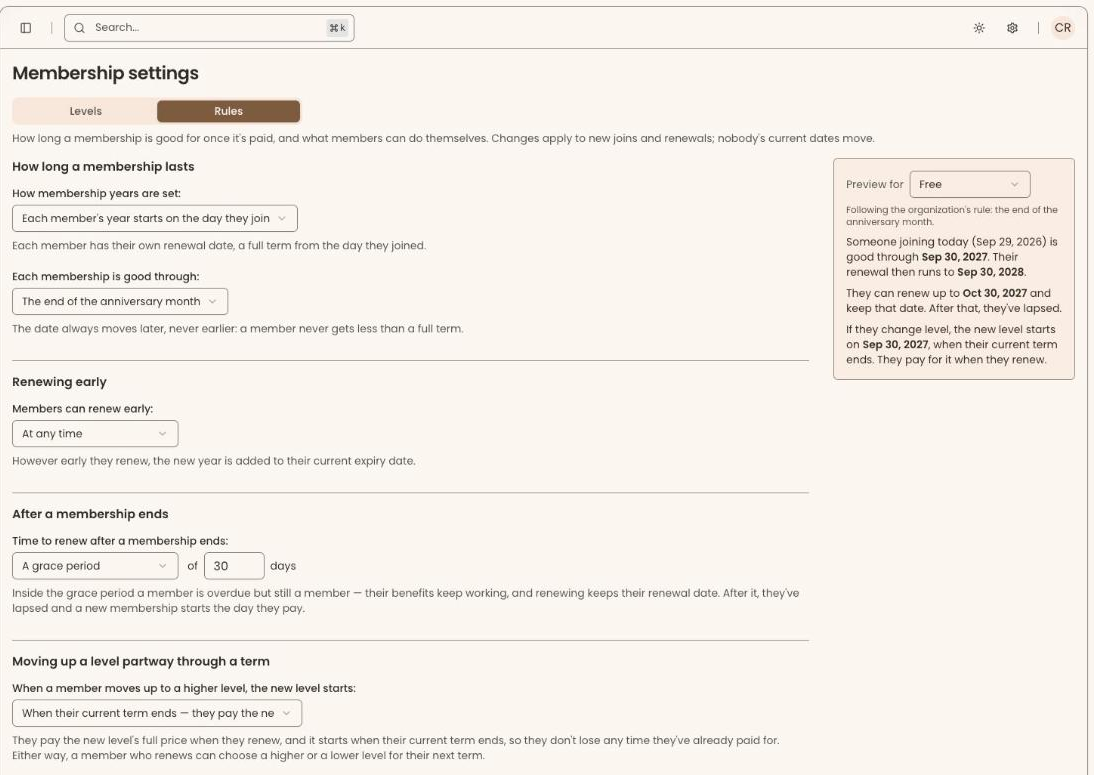
Then the questions begin, and “how do I…” opens up new doors. You begin to question why you’ve built what you’ve built. You hold your position while openly listening to your customers. Some questions create feature requests, some questions are answered “we don't do that today,” and some questions hit at the foundations of your product. For me, it was the question I opened with. Simple, innocuous, and a standard process at any membership-based non-profit. My answer, “Your CRM is the source of truth for the membership. Clerestory is the payment record,” was technically correct and completely wrong.
That’s the beginning of a pivot(al) moment. As a founder, you are told to keep scope tight and build for “one” customer need—to do one thing and to do it really well. You are mindful not to boil the ocean, you stay lean, and you keep true to your vision. Then real customer feedback breaks through. When you care (as much as I do!) about the customer, customer feedback is not just feedback—it’s the roadmap to align your interests.
Putting this story together as the reader, it will now come as no surprise that Clerestory is now a full-featured CRM and payments platform. Yes, as a founder I have now undergone the classic, all-but-certain, pivot that you always hear about.
The pivot was difficult for me. I knew the customer was right, they do need a better CRM, but I was not sure that I should be the one to build it. Incumbents have spent years, decades even, on building full-featured CRMs that maintain records and relationships, send emails and automations, and house custom fields and processes. I know CRMs better than most in the non-profit world given my experience as a leader in the Salesforce community for over a decade. But to build one, from scratch? Not something I desired to do and not something I felt qualified to do. Spoiler: I was wrong.
I sat down and met with a customer and walked through their current CRM (Bloomerang) and I had my “aha!” lightbulb moment—I had already built a CRM but I didn't recognize it because it looked so different than everyone else. My CRM was built on the action, everyone else built their CRM on the database. Think about it, what is the first thing you do when you start with a new CRM? You import your supporters. That is the basic foundation. The incumbent CRMs then use add-ons to perform actions such as payments, events, memberships, auctions, etc. These CRM databases go stale because updates are manual and add-ons—whether in the product or outside—split donor records apart. The legacy model is import a donor > send the donor an email > get a donation > log the record > update the donor. It works, but it's clunky, wasteful, and time consuming. The action-based CRM I built already kept the record up to date, because the action is the update—I had solved the hard part. I just had to add the “standard” fields that were missing like formal and informal greeting names for emails and letters.
That was my aha! In not wanting to build a CRM, I ended up building a new, different kind of CRM. An action-based CRM, where actions form the foundation of the supporter and staff experience rather than a stale database. Sure, I had to add more features into Clerestory—custom fields anyone?—to make it a full CRM that would be recognizable but I was already shipping new features almost daily anyway. I did the research, worked through what a full CRM needs, and shipped it the same way I’d shipped everything else: one feature at a time, tested with real customers.
So I invite you to come meet the new Clerestory, a CRM and payments platform where actions build the supporter profile, the supporter can self-service whatever they need, and insights and actions drive where staff focus their time. And pricing hasn’t changed: a 3% platform fee per successful transaction, plus Stripe’s processing. Supporters can choose to cover both at checkout. No feature gating, no seat licenses, no contracts.