

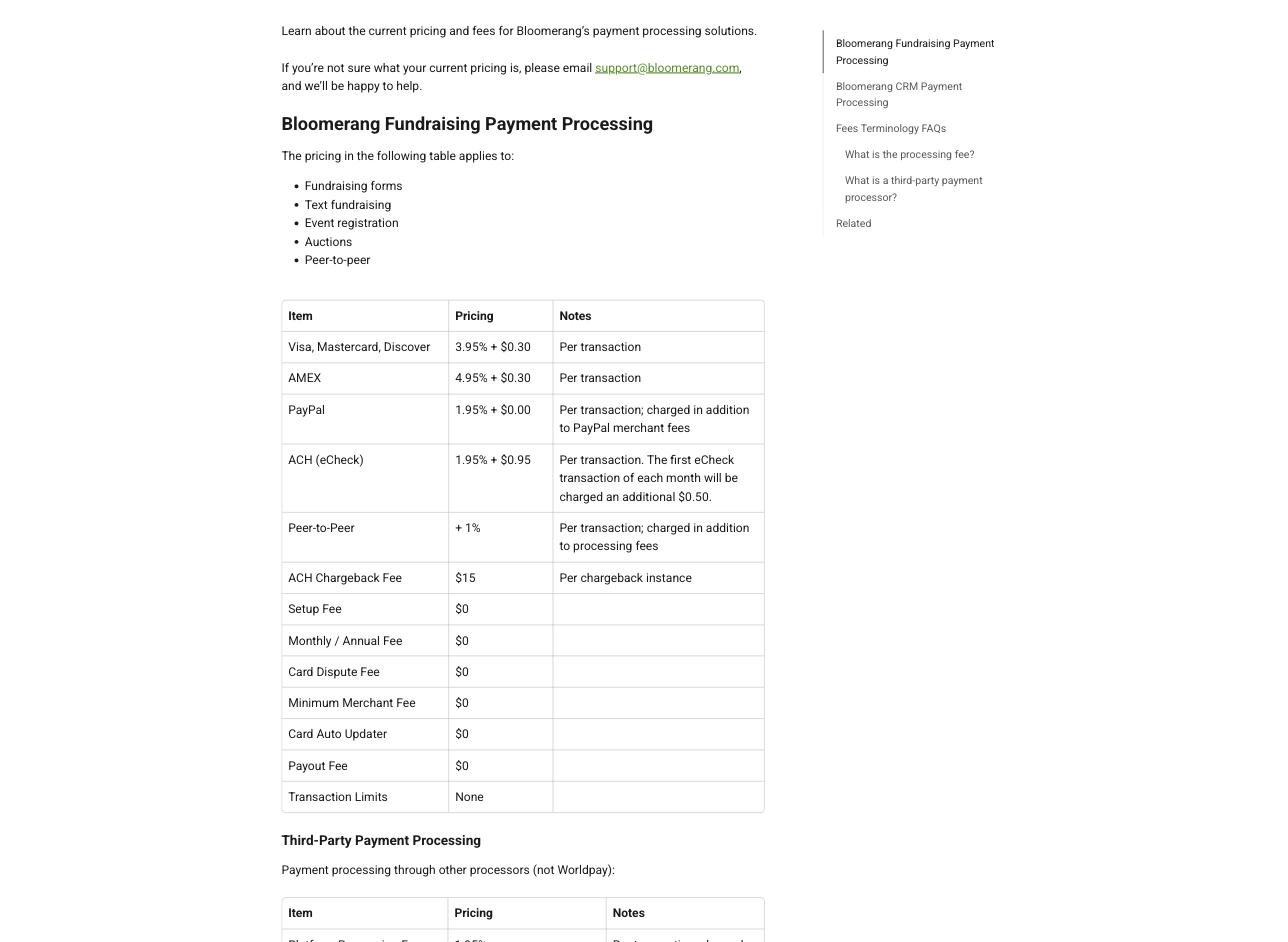
Bloomerang: the Bloomerang Fundraising processing rate table on Bloomerang's own help center, read on 3 September 2026, showing 3.95% + $0.30 for Visa, Mastercard and Discover and 4.95% + $0.30 for American Express.
Most comparison pages are written by the company that wants to win, which is why almost none of them are useful. This one is too, so here is how we have tried to make it worth reading: every claim about Bloomerang below is quoted from Bloomerang's own help center, with the date we read it, and where Bloomerang matches us we say so plainly rather than leaving the row out.
Every screenshot on this page is labeled with whose product it shows.
Two separate things: the software, and the money.
The software. Bloomerang publishes starting prices: The Giving Platform at "$242/month, billed annually", Bloomerang CRM at "$125/month, billed annually" and Bloomerang Fundraising at "$40/month, billed annually", which their pricing page notes "Must be purchased as part of bundle with Bloomerang CRM". Pricing scales with records: "Bloomerang pricing is based on the amount of records, or contacts, you track in the database." Users are unlimited, which is a good position.
Two things are not in those figures. Auctions and Peer-to-Peer are add-ons at $259 per month each. And membership management is an add-on with no published price at all: their help center says "To add membership management to your subscription, contact your account manager." If memberships are why you are shopping, that is the first number to ask for.
The money. This is the part worth slowing down for. Bloomerang Fundraising's published card rates are:
| Method | Bloomerang Fundraising rate |
|---|---|
| Visa, Mastercard, Discover | 3.95% + $0.30 |
| American Express | 4.95% + $0.30 |
| ACH (eCheck) | 1.95% + $0.95 |
Bloomerang CRM runs on different rails and a different, lower schedule: 3.2% + $0.30 for cards including American Express. If a Bloomerang quote is in front of you, establish which product each rate belongs to before comparing anything, because a full percentage point sits between them.
In Bloomerang Fundraising, American Express costs a full percentage point more than Visa, Mastercard and Discover: 4.95% + $0.30 against 3.95% + $0.30.
Major donors and board members disproportionately carry American Express. So does anyone paying a gala table or a sponsorship on a corporate card. This is not a rounding difference on a rare card type; it is a surcharge that lands hardest on your largest gifts.
To be fair to Bloomerang: Bloomerang CRM charges 3.2% flat with no American Express premium at all. The premium is a Bloomerang Fundraising fact, not a Bloomerang fact, and we would rather scope it correctly than score a cheap point.
Bloomerang lets you use a different processor, which sounds like an exit from the rates above. It is not, quite. Their published schedule for "Payment processing through other processors (not Worldpay)" lists a Platform Processing Fee of 1.95%, described in their own words as "Per transaction; charged in addition to merchant processing fees". In Bloomerang CRM the equivalent figure is 1%.
So the choice is their processor at their rate, or your processor at your rate plus a fee to Bloomerang on top.
3% per transaction, and that is the whole of our price. No license fee, no per-seat pricing, no modules, no support tiers, no minimum and no contract. Memberships are not an add-on. Retail is not an add-on. Stripe processes the payment on your own Stripe account at 2.2% + $0.30, the non-profit rate our customers receive.
Supporters can cover both fees at checkout, ours and Stripe's. Across every payment we processed through August 2026, our customers paid an effective 1.65% platform fee on our 3% once supporters had covered their share, and about 1.5% in Stripe processing.
Set Stripe's 2.2% + $0.30 next to Bloomerang's 3.95% + $0.30. That's processing against processing, and theirs is higher. Their subscription, the membership add-on and Auctions all come on top of it.
And 3% is a ceiling, not a floor. Our published Terms of Service say it plainly: "At higher processing volumes, the platform fee may be adjusted or capped at a mutually agreed rate."
Read the right-hand column carefully. "Not documented" does not mean Bloomerang cannot do it. It means we searched Bloomerang's published documentation for it on 3 September 2026 and did not find it. If it exists and we missed it, tell us and we will correct this page.
| Capability | Clerestory | Bloomerang |
|---|---|---|
| Memberships as a product with a term | Yes | Yes, with start and end dates and annual or monthly billing |
| Membership dues for a fixed period | Yes | Yes—"Members commit to monthly or annual (yearly) donations" |
| Card readers and in-person hardware | Yes | Yes, several, from $99 to $139 plus shipping |
| Optional donation added to a ticket purchase | Yes | Yes—"Allow registrants to make a donation without purchasing a ticket or add a donation onto their ticket purchase." |
| Donor option to cover processing fees | Yes | Yes, called GiftAssist—"Use GiftAssist in Bloomerang Fundraising to give donors the option to help offset processing costs." |
| That option available on a membership form | Yes | No—"Membership forms don’t include an option for donors to help cover processing fees." |
| Memberships expiring on a fixed shared date | Yes | Not documented—renewal is described from each member's own start date |
| Memberships without a required processor | Yes | No—"Bloomerang Payments is required if you plan to: Use online membership forms" |
| Timed-entry admission | Partly—walk-up admission is sold by price tier, not by time slot; timed sessions with a capacity can be sold as an event series of dated sessions | Not documented—capacity is a single event-wide cap |
| Sales tax on retail items | Yes | Not documented anywhere, including on the store-item feature |
| Walk-up point of sale | Yes | Inside auction events only—"Check out guests who aren't using the Givi app, or who are paying by cash or check." |
| Online store or gift shop, open year round | Yes | Store items exist only inside the Auctions add-on, tied to an auction event |
| Retail inventory reduced automatically by a sale | Yes | Not documented—an "Available Quantity" field exists; no automatic decrement is described |
| Liability waiver captured at registration | Yes—versioned, required before payment, with signer, timestamp, IP and version hash recorded | Not documented |
| Correct tax receipt per 501(c) entity, per transaction | Yes | Not documented—the EIN is a single account-level value |
| Silent auction with bidding from the guest's own phone | Yes—max bids, buy-now and outbid alerts by email | Yes, in the Auctions add-on to Bloomerang Fundraising |
| Live auction and paddle raise recorded by bidder number | Yes—the auctioneer screen shows the winner's name as the number is typed | Yes—bidder numbers for live items and paddle raises |
| Winners charged in one batch from cards saved at purchase or check-in | Yes—plus a pay link for anyone left owing | Yes—a card added at check-in, and several bidders paid at once at checkout |
| Auction receipts showing fair market value and the deductible amount | Yes | Yes—"the tax-deductible amount is the purchase price minus the fair market value" |
| Raffle tickets sold online and at a table | Yes—singles or bundles, such as 10 for $40 | Yes—event registrations used as raffle tickets, online and in the Virtual Terminal |
| Random raffle draw inside the product, with every draw recorded | Yes—a cryptographically random pick, and refunded tickets cannot win | Not in the product—Bloomerang's own raffle guide suggests an outside website, wheelofnames.com |
| Raffle money kept out of giving history and never receipted as deductible | Yes | Not documented—Bloomerang's raffle setup says "Leave the Fair Market Value at $0.00." |
| Move a payment between a membership and a donation, with a corrected receipt | Yes | Partly—a donation can be converted to a membership payment; the reverse is not documented |
| Membership grace period, and a longer first term or lower first price for late joiners | Yes | Not documented |
| Offer codes on event tickets | Yes—percent off, amount off or a fixed price, with caps and date windows | Yes—promo codes on event registrations |
| Member pricing applied automatically at event checkout | Yes | Not documented |
Clerestory does twenty-five of the twenty-six in full and timed entry in part. Bloomerang matches us on eleven of them, and we have left those eleven in plainly, because a comparison that finds the competitor lacking on everything is one nobody should trust. Bloomerang's membership object is real and dated, its dues handling works, its hardware range is wider than ours, its event forms carry an add-on donation exactly as ours do, and GiftAssist is a proper fee-coverage feature that does the same job ours does across most of the product.
GiftAssist is good, so read its scope rather than its headline. Bloomerang lists the transactions it covers: "Standard donations (one-time and recurring)", event donations and registrations, the virtual terminal, peer-to-peer, auction events, and kiosk. That is six, and membership is not one of them.
Bloomerang says so directly, in a sentence they publish twice, in two separate articles: "Membership forms don’t include an option for donors to help cover processing fees."
So on the single transaction where an organization most wants the member to cover the cost—a renewal, arriving on a predictable date, from someone who has already chosen to support you—the option is not there, and the organization absorbs the processing fee on every membership it sells.
Combine that with the rate: a $200 membership on a Visa card at 3.95% + $0.30 is $8.20 the organization cannot ask the member to cover. On a thousand memberships that is $8,200 a year, and no member was ever given the chance to say yes.
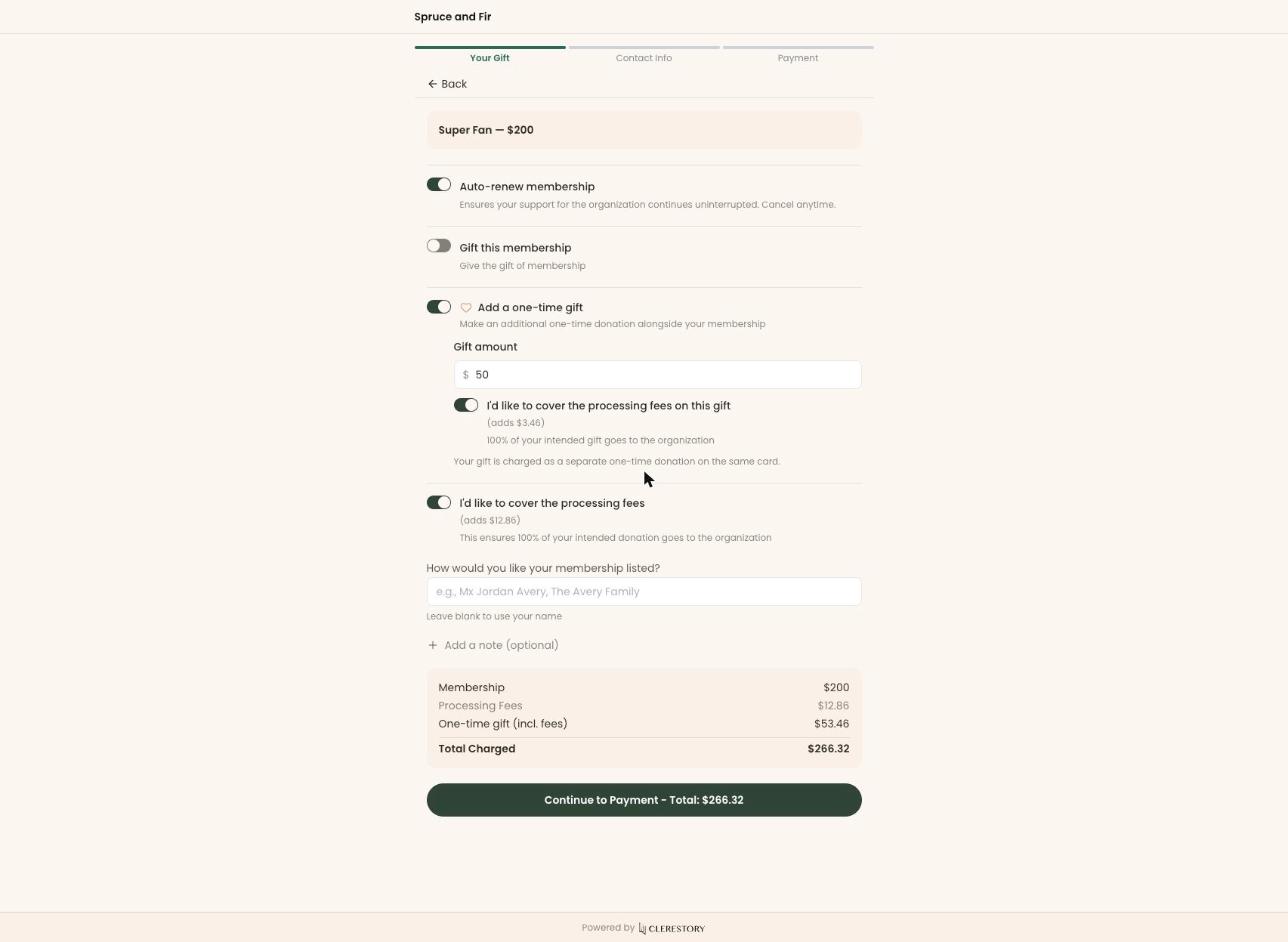
This is the Clerestory kiosk mid-transaction. Six of the rows above are visible in one screen.

Admission, retail and a donation in one cart against one member record, with sales tax calculated and stock decremented. On Bloomerang's side, the shop lives inside a $259-per-month auction module, the point of sale is an auction checkout screen, and sales tax is not documented at all.
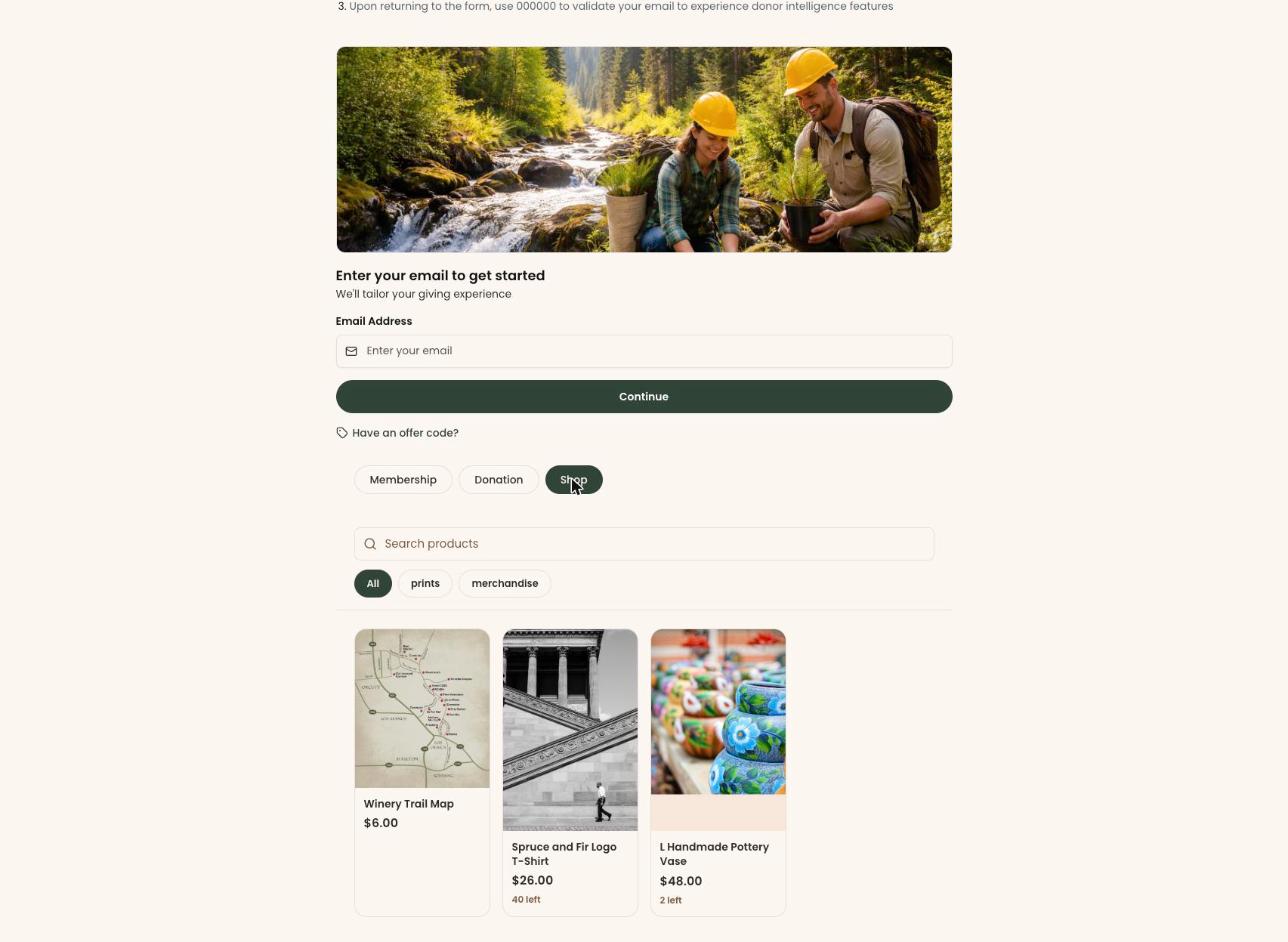
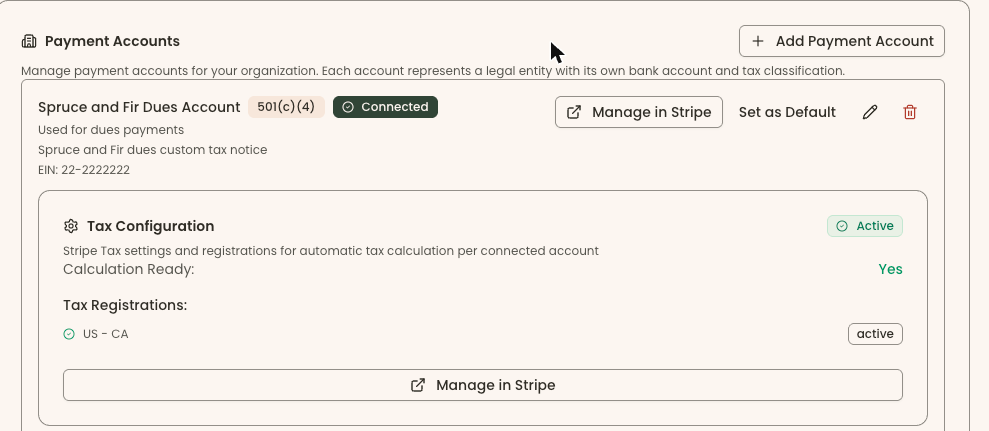
Bloomerang's organization settings hold one EIN, account-wide. Their form-level receipt settings let you customize the title, sender name, reply-to address, subject and body—but not the tax identifier. Chapters exist as parent and child accounts, enabled case by case, and nothing documents each entity issuing receipts under its own EIN.
In Clerestory each entity is a payment account. Its own EIN, its own tax classification, its own bank account, and its own tax notice on the receipt. Every campaign routes revenue to the account you choose, so the gift lands against the right entity and the receipt carries the right EIN at the moment it is sent, rather than being corrected afterwards.
Bloomerang runs a full auction in its Auctions add-on, and on the auction rows it matches us: bidding from a phone, bidder numbers for live items and paddle raises, a card at check-in, and receipts that subtract fair market value. The raffle is where it thins out. Tickets are sold as event registrations, the guide suggests an outside website for the draw, and the setup guide says "Leave the Fair Market Value at $0.00"—we found nothing documenting that a raffle ticket is receipted as non-deductible. Auctions and raffles live in Bloomerang Fundraising; memberships live in Bloomerang CRM.
Auctions and raffles are now part of Clerestory, in the same account as memberships, admission and the gift shop. Guests bid on silent items from their own phones, with max bids, buy-now and outbid alerts by email. The auctioneer records live items and paddle-raise levels by bidder number, and a big screen in the room shows the running total and the countdown to each close. After the event every saved card is charged in one batch, with a pay link for anyone left owing. Each guest's statement separates fair market value from the deductible amount, and a paddle-raise gift lands in the donor's giving history as a gift.
Raffles run on their own or inside an event, sold online or at a table. A numbered raffle is drawn inside Clerestory with a cryptographically random pick, and every press of the button is recorded, so a re-draw is visible rather than silent. Raffle money counts as money raised, never as giving, and it is never receipted as deductible.
Memberships and events moved too. Membership rules now cover a shared membership year or a rolling one, a grace period, an early-renewal window, and a longer first term or a lower first price for late joiners. A payment recorded against the wrong thing—a membership paid through the donation form, say—can be moved between membership and donation after the fact without charging anyone again, and the donor receives a corrected receipt that replaces the earlier one. Event offer codes give percent off, an amount off or a fixed price, capped and dated, and signed-in members get member pricing automatically.
Bloomerang is a mature CRM with a real membership object, a proper dues concept, an unusually wide range of card readers, a working fee-coverage feature in GiftAssist, and the good manners to publish its processing rates when much of the industry will not. On eleven of the twenty-six rows above it does exactly what we do.
If your organization is fundraising-led, your members are essentially recurring donors, and your in-person work is a gala and an auction once a year, Bloomerang is built for that and it is a credible choice.
Three questions decide it the other way. Can your members choose to cover the processing fee? GiftAssist covers six kinds of transaction and membership is not among them. What does a card actually cost, and does an American Express gift cost more? In Bloomerang Fundraising, 3.95% and yes, a full point more. And is the shop open in March, or only when an auction is running?
If you are large enough that a percentage of everything makes you uneasy, say so early. Our terms already provide for the platform fee to be adjusted or capped at a mutually agreed rate at higher processing volumes, documented in writing between us and published where you can read it before you ever speak to us. Then ask both of us the same two questions: what does the software cost, and what does the processing cost? Ours are 3% and 2.2% + $0.30, and your supporters can cover both.
We read Bloomerang's own website and help center on 12 October 2026 to compare the two products as a CRM. Clerestory now includes a full supporter CRM, so this section covers the CRM work Bloomerang is best known for. Every Bloomerang quote is linked to the page it comes from. "Not documented" means we searched Bloomerang's help center and did not find it, not that it cannot be done.
| Capability | Clerestory | Bloomerang |
|---|---|---|
| Supporter engagement score | Yes, called Warmth, scored 0–100 | Yes—"Bloomerang CRM calculates a constituent's engagement level based on a proprietary formula" Source |
| A plain-English reason for every point of the score, with a 90-day trend | Yes | Not documented. Bloomerang lists the factors in general and describes the formula as proprietary Source |
| Wealth and giving-capacity rating | No | Yes, the Generosity Score—"based only on the DonorSearch (DS) rating for a constituent" and "available to all Bloomerang CRM customers at no cost" Source |
| Households where each member keeps their own record and giving history | Yes | Yes—"Maintaining separate records for each member of the household lets you communicate with them individually" Source |
| Person-to-person and person-to-business relationships | Yes | Yes—"Relationships are a record of how your constituents are connected to each other." Source |
| Reports and mailings by household | Yes, including one piece per household | Yes—"This should give you a list of households whose last gift was between 12-13 months ago." Source |
| A membership that covers other household members, with the member choosing who is covered | Yes | Not documented. Bloomerang says "Membership information appears on the constituent profile for only the constituent who joined the membership program." Source |
| Membership management included | Yes | Add-on—"To add membership management to your subscription, contact your account manager." Source |
| Built-in email with open and click tracking | Yes, on appeals and newsletters | Yes—the timeline shows "Whether the constituent opened the email, clicked a link, or unsubscribed." Source |
| Email sent from your own domain | No. Email sends from the Clerestory domain under your organization's name, and replies go to you | Yes—"you can use a custom sender address from your own domain." Source |
| Separate opt-outs for different kinds of email | Yes, appeals and newsletters separately, with one-click unsubscribe | Yes—"Your constituents can subscribe (opt in) to or unsubscribe (opt out) from email interests." Source |
| Multi-step automations | Yes, started by a gift, joining, renewing, lapsing, a first visit, event attendance, a tribute gift or reaching a donor level | Yes—"A step can send an email, assign a task, assign a relationship manager, or add a time delay." Source |
| A thank-you letter drafted when a gift is recorded | Yes, automatically | Yes, when staff add the donation—"If you selected Letter, you can also select Generate Letter on Save." Source |
| Letter templates and batch letters | Yes, PDF letters on your letterhead, plus mailing labels | Yes—"To generate a batch of letters" Source |
| Outside emails logged on the supporter's timeline | Yes, by BCC | Yes—"Using BCC to Bloomerang, forward emails from your personal email account to Bloomerang." Source |
| Supporter timeline | Yes | Yes—"On the Timeline page, view all date-based activities associated with a constituent for each calendar year." Source |
| Duplicate detection and merge | Yes, matched nightly, merged field by field | Yes—"Constituents are considered to be potential duplicates when:" followed by matching rules Source |
| Undo a merge | Yes, for 30 days | No—"Merging constituents is permanent." Source |
| Tribute gifts with family notification | Yes | Yes—"A tribute can also have a notificant, someone your organization notifies when a gift is made." Source |
| Volunteer shifts and hours | Yes, included | Separate product—Bloomerang Volunteer, starting at $119 a month, billed annually Source |
| Grant tracking | Yes | Yes—"Create and assign tasks for deadlines, reports, and check-ins throughout the grant process." Source |
| Relationship owner and a personal portfolio | Yes | Yes—relationship managers can "Quickly review their portfolio of assigned constituents" Source |
| Donor levels on lifetime or rolling 12-month giving | Yes | Fiscal year—"A constituent’s giving level is based on their highest total giving amount in any fiscal year." Source |
| LYBUNT and SYBUNT lists | Yes | Yes—"Bloomerang CRM provides easy reporting and segmentation tools to identify LYBUNT and SYBUNT donors" Source |
| Text messaging to supporters | No | Yes—"you can give donors the option to opt in to text message communications." Source |
| Public API | No | Yes—"The REST API is a private key API. It is for server-to-server integrations." Source |
| Mailchimp sync | Yes, two-way | Yes, documented in Bloomerang's email integrations Source |
| QuickBooks Online | Yes | Yes—"Bloomerang CRM to QuickBooks Online: Sync Transactions" Source |
| Price stays the same as your contact list grows | Yes. No license fee and no contact tiers | No—the license has a record limit, and "Yes, inactive constituents do count towards your account license limit." Source |
Bloomerang is a mature donor CRM. Its customers get a giving-capacity rating, the Generosity Score, built on DonorSearch data at no cost, and Clerestory does not rate wealth. Bloomerang can also send email from your own domain, offers text messaging, and publishes a REST API for organizations with their own developers. On the everyday CRM basics the two products are close: households, relationships, a supporter timeline, built-in email with open and click tracking, separate opt-outs, multi-step automations, batch letters, tributes, grant tracking, portfolios, LYBUNT and SYBUNT lists, Mailchimp and QuickBooks Online are documented in both. We count those as ties, not wins.
Clerestory's CRM sits on the same records as every payment, so the supporter file fills itself. A renewal, a first visit, event attendance or a tribute gift can start an automation, and a thank-you letter is drafted automatically when a gift is recorded. Event check-ins, kiosk visits, shop purchases and volunteer hours all move a supporter's Warmth score, and every point of that score comes with a plain-English reason. Email opens are deliberately left out of the score, because Apple Mail Privacy Protection makes them unreliable.
Memberships are included rather than sold as an add-on, and a level can cover a household, with the member choosing who is covered in their own portal. Covered people count as members everywhere: in lists, reports, admission, the kiosk and Mailchimp. Volunteers are included too, where Bloomerang sells Bloomerang Volunteer as its own product. A duplicate merge can be undone for 30 days; Bloomerang says its merges are permanent. And the price does not rise as your list grows. Bloomerang's license has a record limit that counts inactive records too. Clerestory charges per transaction, with no license fee.
On 3 September 2026 we read Bloomerang's own help center and pricing page, and verified every quote and every rate above against the live pages in a browser rather than trusting an automated fetch. We did not use G2, Capterra, or any comparison site, and we did not treat marketing pages as evidence of what the software does.
On 29 September 2026 we added eleven rows—auctions, raffles, membership rules, moving a payment and event offer codes—and checked each against Bloomerang's own help center on that date. Where a cell quotes Bloomerang, the quote is from Bloomerang's own page.
On 12 October 2026 we added the CRM section, reading Bloomerang's own help center, pricing page, grant management page, nonprofit glossary and REST API page on that date, and checked every quote in a browser. Each row links to the Bloomerang page it quotes. To check whether a Bloomerang membership can cover other household members, we searched the help center for "household" and "family membership" and found no such option.
One thing we deliberately did not claim: Bloomerang references a payment-capable kiosk in its documentation but never defines it, so we have neither credited it with a self-service kiosk nor said it has none. We would rather leave a row out than guess at it.
Corrected 30 September 2026: Clerestory sells admission by price tier, not by time slot; timed sessions can be sold as an event series.
Screenshots labeled Clerestory are from a Clerestory demo organization with test data. Screenshots labeled Bloomerang are from Bloomerang's own help center. Every quote is reproduced as it stood on 3 September 2026. Documentation moves and products change. If anything here is out of date or wrong, tell us and we will correct it.
Clerestory is an alternative to Bloomerang that includes memberships, a year-round gift shop, auctions, raffles and admission in one price of 3% per transaction, with no subscription and no add-ons. As of 3 September 2026, Bloomerang's auctions are a $259-per-month add-on and membership management is an add-on with no published price.
On processing, yes: our customers pay Stripe 2.2% + $0.30, against Bloomerang Fundraising's 3.95% + $0.30, and 4.95% + $0.30 on American Express, as of 3 September 2026. On software, Bloomerang's Giving Platform starts at $242 a month billed annually and ours is 3% per transaction, but supporters can cover our fee, and nobody can cover a subscription for you.
Yes, when an organization uses its own processor. As of 3 September 2026, Bloomerang lists a Platform Processing Fee of 1.95% per transaction in Bloomerang Fundraising, and 1% in Bloomerang CRM, charged on top of the merchant's own processing fees. The software is a subscription, starting at $125 per month for Bloomerang CRM, billed annually.
No. As of 3 September 2026, Bloomerang's help center says membership forms do not include an option for donors to help cover processing fees. Clerestory offers fee coverage on membership checkout, and separately on a gift added to it.
Bloomerang offers a wider range of card readers than Clerestory. On the CRM side, as of 12 October 2026, Bloomerang gives its CRM customers a free giving-capacity rating, the Generosity Score, built on DonorSearch data. It can also send email from your own domain, send text messages to supporters and connect through a public REST API. Clerestory does none of those today. On the twenty-six capabilities in the feature-by-feature table, Clerestory does twenty-five in full and timed entry in part, and Bloomerang matches on eleven, including memberships with a term, auctions with bidder numbers and a working fee-coverage feature called GiftAssist.
For everyday CRM work, yes. Clerestory covers the CRM work Bloomerang is known for: households, relationships, a supporter timeline, built-in email with open and click tracking, multi-step automations, tributes, grants, portfolios, LYBUNT and SYBUNT lists, Mailchimp and QuickBooks Online. As of 12 October 2026 it does not offer wealth screening, text messaging, sending from your own email domain or a public API, and Bloomerang does. If you rely on any of those, Bloomerang still has them.
Both score how engaged a supporter is. Bloomerang describes its engagement level as "based on a proprietary formula". Clerestory's Warmth score runs from 0 to 100, shows a plain-English reason for every point and a 90-day trend, and draws on giving, membership, event check-ins, kiosk visits, shop purchases, volunteer hours and email clicks. Bloomerang also has a separate Generosity Score for giving capacity, built on DonorSearch ratings. Clerestory does not rate wealth.