


Most comparison pages are written by the company that wants to win, which is why almost none of them are useful. This one is too, so here is how we have tried to make it worth reading: every claim about Greater Giving below is quoted from Greater Giving's own website or help center, with the date we read it, and where Greater Giving matches us we say so plainly rather than leaving the row out.
Every screenshot on this page is labeled with whose product it shows.
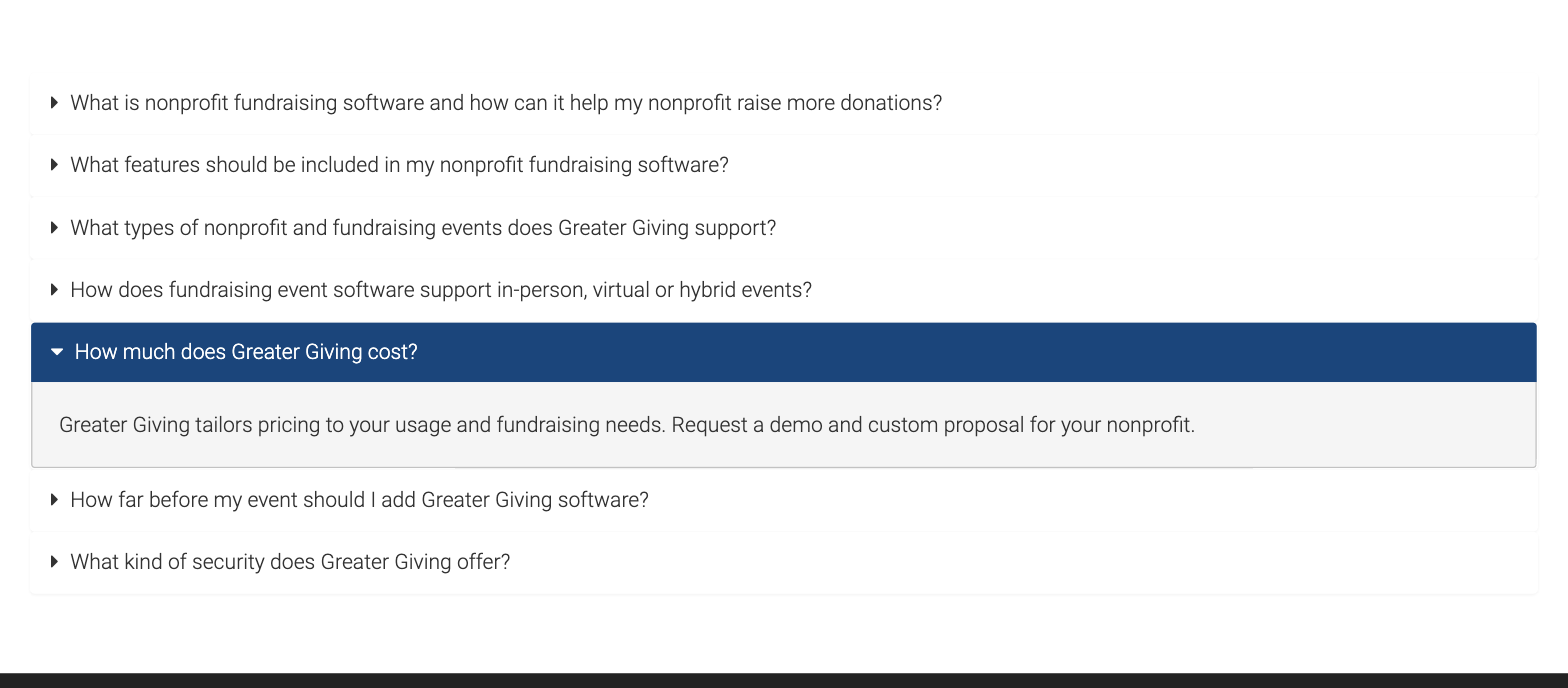
How much does Greater Giving cost?
Greater Giving does not publish a price. On 29 September 2026 we checked its homepage, its Express and Event package pages, its package comparison page and its terms of use. None carries a figure, a range or a starting-from number, and there is no pricing page. Each offers a demo.
Its own FAQ asks the question and answers it, which we will quote rather than characterize. Asked "How much does Greater Giving cost?", the answer is: "Greater Giving tailors pricing to your usage and fundraising needs. Request a demo and custom proposal for your nonprofit."
Three layers, none of them published
The marketing site tells you how to find out the price. The public help center tells you what the price is made of. It does not give amounts, but it does give the shape.
- An annual software fee. "Invoices are usually for your organization's annual software fee or for Supporter refunds."
- A service fee to Greater Giving on every card payment, on top of processing: "All transactions have a Pass Thru Fee, which is paid to the credit card companies (Visa, MasterCard, etc) and a Service Fee, which is paid to Greater Giving."
- Card processing, which is that Pass Thru Fee.
Statements can also show "equipment rental fees" for the card readers shipped to your event. And the amounts are private by design: "Fees are outlined in the Agreement you have with Greater Giving. They are unique to each organization."
So you pay Greater Giving twice—once a year for the software, and again on every transaction—and the one number that would let you compare vendors, the all-in cost per dollar raised, cannot be computed from anything Greater Giving publishes.
What you are signing
The agreement renews itself. Greater Giving's help center says "Note that all agreements automatically renew unless you tell us otherwise," and its FAQ describes "an agreement with Greater Giving that renews annually. The agreement contains all of the important details about your account such as your renewal date, pricing, and what products you have access to."
Two details are worth knowing before you sign. Only named people can discuss it: "Please note that Client Services can only discuss the Agreement with approved Financial Contacts." And the annual fee is invoiced "a few weeks prior to your annual renewal date", which is the window in which to decide whether you are staying.
What does Clerestory cost?
3% per transaction, and that is the whole of our price. No license fee, no per-seat pricing, no modules, no support tiers, no minimum and no contract. You never receive a bill from us, because the fee comes out at the time of the payment—and if you refund a gift, our 3% comes back with it. Stripe processes the payment on your own Stripe account at 2.2% + $0.30, the non-profit rate our customers receive.
The number that matters is the all-in one. Across every payment we processed through August 2026, our customers' all-in cost—software and card processing together—was 3.148%. Bare Stripe at its standard 2.9% + $0.30, with no software at all, would have cost 3.177% on the very same payments.
And 3% is a ceiling, not a floor. Our published Terms of Service say it plainly: "At higher processing volumes, the platform fee may be adjusted or capped at a mutually agreed rate." Three per cent is the most anyone pays us, and it is the only direction the number moves.
Clerestory vs Greater Giving, feature by feature
Read the right-hand column carefully. "Not documented" does not mean Greater Giving cannot do it. It means we searched Greater Giving's public help center for it on 29 September 2026 and did not find it. If it exists and we missed it, tell us and we will correct this page.
| Capability | Clerestory | Greater Giving |
|---|---|---|
| Price published on the vendor's own website | Yes, 3% per transaction | No—"Greater Giving tailors pricing to your usage and fundraising needs." |
| No minimum contract term | Yes | No—an annual agreement, and "all agreements automatically renew unless you tell us otherwise" |
| Process on your own Stripe account | Yes | Not documented—Greater Giving processes the card payments itself and deposits the funds to your bank |
| Donor option to cover processing fees | Yes | Yes—a "convenience fee" set as a flat amount or a percentage, which "can be optional or mandatory" |
| Card readers and in-person hardware | Yes | Yes—USB, mobile and Bluetooth readers, shipped per event: "We deliver your order 4 business days before your event date" |
| Walk-up point of sale | Yes | Yes, at events—Go Time Storefront "operates much like a graphical Point of Sale system" |
| Optional donation added to a ticket purchase | Yes | Yes—the registration module "can also be used to process donations or sell items at a set price" |
| Class or workshop registration | Yes | Yes—the registration module "is designed for your Supporters to buy tickets to an actual physical event, class, or workshop" |
| Sales tax on retail items | Yes | Yes—a project default rate plus per-item rates, documented for purchases "such as on auction packages" |
| Online store or gift shop | Yes | Yes—a standalone Merchandise Sales Page is among Greater Giving's own sample pages |
| Memberships as a product with a term and expiry | Yes | Not documented—membership pages are described as "collecting single payments in reference to Memberships", with no term, expiry or renewal documented |
| Timed-entry admission | Partly—walk-up admission is sold by price tier, not by time slot; timed sessions with a capacity can be sold as an event series of dated sessions | Not documented |
| Retail inventory reduced automatically by a sale | Yes | Partly—online pages can cap quantities, but "only transactions completed on the Project Website page (not manual sales or Online Bidding sales) will be counted against the limits" |
| Self-service kiosk | Yes | Not documented—a help center search for "kiosk" returns no results |
| Liability waiver captured at registration | Yes—versioned, required before payment, with signer, timestamp, IP and version hash recorded | Not documented—a help center search for "waiver" returns no results |
| Correct tax receipt per 501(c) entity, per transaction | Yes | Not documented—receipts carry "your organization's Tax ID", singular |
| Silent auction with bidding from the guest's own phone | Yes—max bids, buy-now and outbid alerts by email | Yes—a personal bidding link, with max bids: "Bidding will automatically continue in your favor until your max bid is reached" |
| Live auction and paddle raise recorded by bidder number | Yes—the auctioneer screen shows the winner's name as the number is typed | Yes—Go Time enters each sale by "name or bid number", and Fund-a-Need levels show on a giving board |
| Winners charged in one batch from cards saved at purchase or check-in | Yes—plus a pay link for anyone left owing | Yes—cards collected at check-in are charged in a charge batch after the event |
| Auction receipts showing fair market value and the deductible amount | Yes | Yes—receipts show the Package Value, "the non-tax deductible portion of the Sale", and the amount paid above it |
| Raffle tickets sold online and at a table | Yes—singles or bundles, such as 10 for $40 | Yes—raffle tickets are multiple-sale packages, sold online and at Go Time Storefront |
| Random raffle draw inside the product, with every draw recorded | Yes—a cryptographically random pick, and refunded tickets cannot win | Not documented—a help center search for "drawing" returns nothing about raffles |
| Raffle money kept out of giving history and never receipted as deductible | Yes | Partly—set by hand on each package: "if it is not tax deductible, the Value should be the same as the Price" |
| Move a payment between a membership and a donation, with a corrected receipt | Yes | Not documented |
| Membership grace period, and a longer first term or lower first price for late joiners | Yes | Not documented—membership pages take single payments |
| Offer codes on event tickets | Yes—percent off, amount off or a fixed price, with caps and date windows | Yes—discount codes on registration pages, as a flat amount or a percentage |
| Member pricing applied automatically at event checkout | Yes | Not documented |
Clerestory does twenty-six of the twenty-seven in full and timed entry in part. Greater Giving matches us on thirteen of them, and partly on two more. We have left those rows in plainly, because a comparison that finds the competitor lacking on everything is one nobody should trust.
Where the product boundary sits
Greater Giving is event software first. Its own FAQ recommends "securing Greater Giving software at least 3-6 months before your event," and its help center splits the product in two: the Event Software and Go Time for the event itself, and standalone Online Payments pages for donations, memberships, tuition and merchandise.
The two halves do not share everything. Memberships live only on the second side: "Membership Modules should only be added to standalone Online Payments Pages, which are not connected to the Event Software in any way." The money runs on two tracks as well, with "two different types of statements: Auctionpay (EPINV) and Online Payments (OPINV)", deposited on two different schedules.
Those schedules are worth reading. Online payments are "deposited every Friday for the previous week's transactions. For example, transactions processed on Saturday, April 1st through Friday, April 7th would be deposited on Friday, April 14th." That is 13 days for a Saturday gift. Event, Go Time and Online Bidding charges are "deposited 5 business days after you charge the cards."
Whose Stripe account is it?
This is the row that matters most to a finance committee and gets the least attention.
On Greater Giving, Greater Giving processes the payment and pays you out. Its refund documentation puts it in the first person: "Greater Giving can refund money to your supporters for any credit card transaction that we process." Changing the bank account it pays into is a paper process—a cover sheet with a voided check or a letter from your bank—and on 29 September 2026 its help center said "THE ONLINE BANKING UPDATE PORTAL IS NOT AVAILABLE AT THIS TIME."
In Clerestory, payments are processed on your own Stripe account. Your organization is the merchant of record, the payout schedule is yours, the dispute history is yours, and if you ever leave us the account and its history stay with you.
What one sale looks like
This is the Clerestory kiosk mid-transaction. Several of the rows above are visible in one screen.

Admission, retail and a donation are in the same cart, on the same tap, against the same member record, on any day of the year rather than on event night.
What a liability waiver actually has to survive
Collecting a tick box is easy. The question an insurer or a court asks is what you can produce afterwards. We searched Greater Giving's help center for "waiver" on 29 September 2026 and it returned no results.
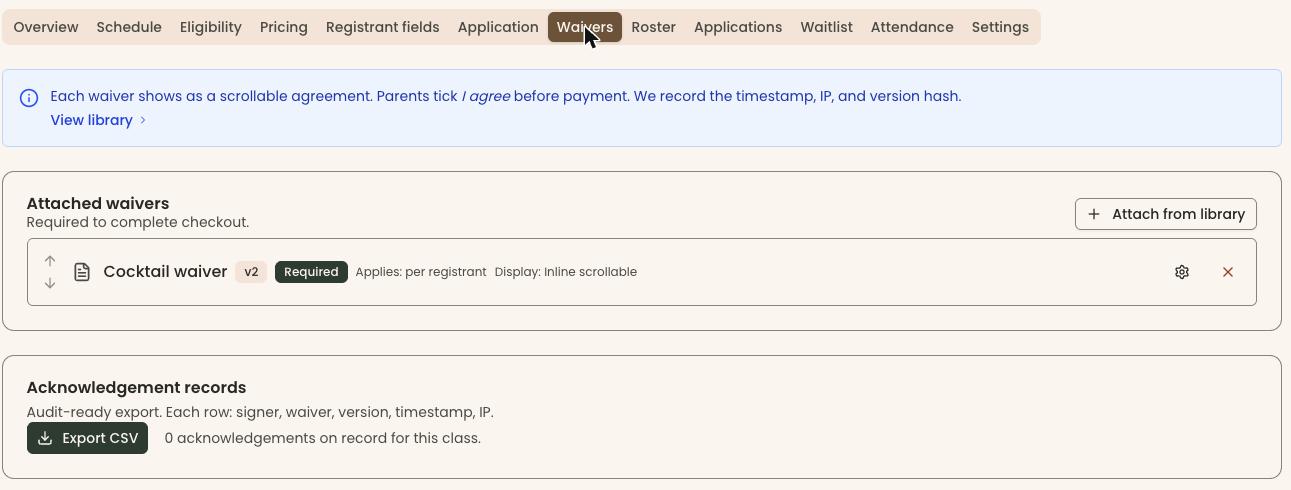
The version hash matters more than it sounds. If you revise a waiver mid-season, you can still show which wording a given family actually agreed to.
If you run more than one 501(c) entity, ask this question first
A museum and its foundation. A society and its endowment. A club and its charitable arm. Two legal entities, two EINs, and every dollar has to land against the right one.
Greater Giving's receipts carry one number. The receipt setting "Automatically includes your organization's Tax ID at the footer of the Receipt," and changing that Tax ID runs through support with documentation "such as a 990 form": "Name and tax ID changes can take up to 10 business days to complete."
In Clerestory each entity is a payment account. It has its own EIN, its own tax classification, its own bank account, and its own tax notice on the receipt. Every campaign routes its revenue to the account you choose, so the gift lands against the right entity and the receipt carries the right EIN at the moment it is sent, rather than being corrected afterwards.
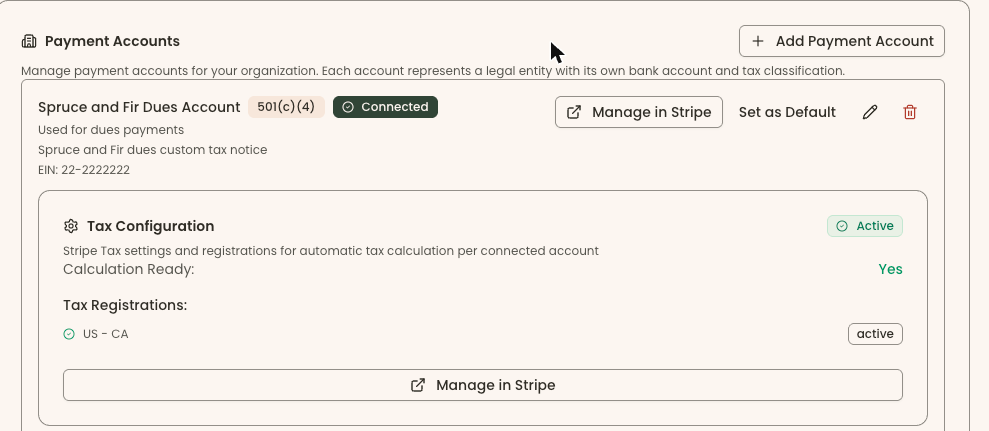
You move between them from one login. There is no ceiling of two, and there is no support ticket in the process.
Auctions, raffles and the other new rows
Greater Giving is auction software first, and on the auction rows above it matches us: bidding from a phone with max bids, live sales entered by bid number, a charge batch after the night, and receipts that separate value from gift. Where it stops is the raffle. We could not find a draw in its help center, deductibility is set by hand on each package, and a bundle needs a package of its own: "For example, one Package: Raffle Ticket for $5 and another Package: 5 Raffle Tickets for $20."
Auctions and raffles are now part of Clerestory, in the same account as memberships, admission and the gift shop. Guests bid on silent items from their own phones, with max bids, buy-now and outbid alerts by email. The auctioneer records live items and paddle-raise levels by bidder number, and a big screen in the room shows the running total and the countdown to each close. After the event every saved card is charged in one batch, with a pay link for anyone left owing. Each guest's statement separates fair market value from the deductible amount, and a paddle-raise gift lands in the donor's giving history as a gift.
Raffles run on their own or inside an event, sold online or at a table. A numbered raffle is drawn inside Clerestory with a cryptographically random pick, and every press of the button is recorded, so a re-draw is visible rather than silent. Raffle money counts as money raised, never as giving, and it is never receipted as deductible.
Memberships and events moved too. Membership rules now cover a shared membership year or a rolling one, a grace period, an early-renewal window, and a longer first term or a lower first price for late joiners. A payment recorded against the wrong thing—a membership paid through the donation form, say—can be moved between membership and donation after the fact without charging anyone again, and the donor receives a corrected receipt that replaces the earlier one. Event offer codes give percent off, an amount off or a fixed price, capped and dated, and signed-in members get member pricing automatically.
Which is the better fit for your organization?
We are not going to pretend Greater Giving is a bad product. It is built for fundraising events, and on thirteen of the twenty-seven rows above it does what we do.
Three questions decide it the other way.
Can you find out what it costs? An annual software fee, a service fee on every transaction and card processing, and not one of the three is published. Ours is 3%, it is the whole price, and it is on the page.
How long are you committing for? An annual agreement that renews itself unless you say otherwise. We have no term at all.
Does the institution have a door? A self-service kiosk, memberships with a term and an expiry, a waiver on file, and two EINs on two sets of receipts are the things we could not find documented on Greater Giving's side. If most of that describes your week rather than one night of your year, that is the difference.
If you are large enough that a percentage of everything makes you uneasy, say so early. Our terms already provide for the platform fee to be adjusted or capped at a mutually agreed rate at higher processing volumes, documented in writing between us and published where you can read it before you ever speak to us.
Then ask both of us the same question: what is the all-in cost per dollar raised, counting license, platform fee and card processing together? Ours is 3.148% and the working is above.
How we checked
On 29 September 2026 we read Greater Giving's homepage, package pages and terms of use, and searched and read its public help center in a browser, because that help center does not render for an automated fetch. We did not use G2, Capterra, or any comparison site, and we did not treat Greater Giving's marketing pages as evidence of what the software does. Where the help center returned no results for a capability, we say so rather than calling it missing.
On 29 September 2026 we added eleven rows—auctions, raffles, membership rules, moving a payment and event offer codes—and checked each against Greater Giving's own website and help center on that date. Where a cell quotes Greater Giving, the quote is from Greater Giving's own page.
Corrected 30 September 2026: Clerestory sells admission by price tier, not by time slot; timed sessions can be sold as an event series.
Screenshots labeled Clerestory are from a Clerestory demo organization with test data. Every quote is reproduced as it stood on 29 September 2026. Documentation moves and products change. If anything here is out of date or wrong, tell us and we will correct it.
Frequently asked questions
What is a good Greater Giving alternative for small non-profits?
Clerestory is an alternative to Greater Giving that runs auctions, raffles, memberships, admission, the gift shop and donations in one account, on the organization's own Stripe account, for 3% per transaction with no contract. Greater Giving is event fundraising software first, and as of 29 September 2026 its memberships live only on standalone Online Payments pages that are not connected to its Event Software.
Is Clerestory cheaper than Greater Giving?
Nobody can say from published numbers, because Greater Giving publishes none of its three costs: an annual software fee, a service fee on every card payment and card processing, as of 29 September 2026. Clerestory's price is 3% per transaction plus Stripe processing, and customers' all-in cost across every payment through August 2026 was 3.148%.
Does Greater Giving charge a platform fee?
Yes. Greater Giving's help center says every transaction carries a Pass Thru Fee paid to the card companies and a Service Fee paid to Greater Giving, on top of an annual software fee, as of 29 September 2026. The amounts are not published; Greater Giving says fees are outlined in each organization's agreement and are unique to each organization.
Does Greater Giving require an annual contract?
Yes. Greater Giving describes an agreement that renews annually, and its help center says all agreements automatically renew unless the organization says otherwise, as of 29 September 2026. Clerestory has no contract, no minimum and no license fee.
What does Greater Giving do that Clerestory does not?
On the twenty-seven capabilities this comparison checked, none: Clerestory does twenty-six in full and timed entry in part. Greater Giving matches Clerestory on thirteen, including phone bidding with max bids, live sales entered by bid number, batch charging after the event and auction receipts that separate value from gift, and partly matches on two more.