


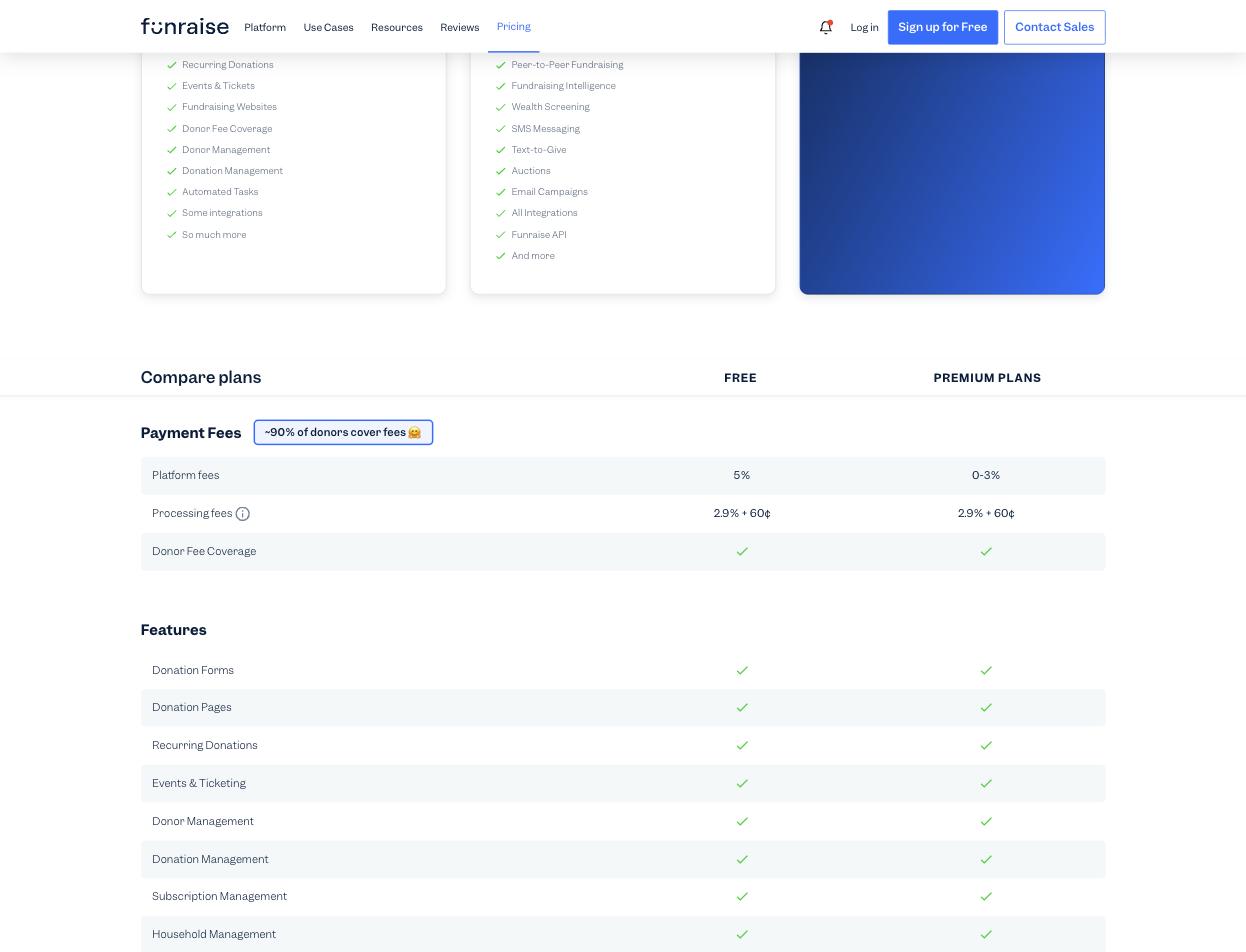
Funraise: the Compare plans table on Funraise's own pricing page, read on 3 September 2026, showing a 5% platform fee on the free plan, 0–3% on Premium, and 2.9% + 60¢ processing on both.
Most comparison pages are written by the company that wants to win, which is why almost none of them are useful. This one is too, so here is how we have tried to make it worth reading: every claim about Funraise below is quoted from Funraise's own site or help center, with the date we read it, and where Funraise matches us we say so plainly rather than leaving the row out.
Every screenshot on this page is labeled with whose product it shows.
Funraise publishes a free plan and a fee schedule, which is more than most of this market does, and they deserve credit for it.
The free plan comes with an eligibility condition, in their words: "Funraise is a free, fee-based, fundraising and donor management platform for organizations raising under $1 million annually." Setup is genuinely free too—asked "Are there setup fees?" their pricing page answers "Nope."
The fee schedule is where the real price lives:
| Free | Premium Plans | |
|---|---|---|
| Platform fees | 5% | 0–3% |
| Processing fees | 2.9% + 60¢ | 2.9% + 60¢ |
Premium plan pricing is not published; it is a conversation with sales. American Express costs more on top: "American Express payments incur an additional 1% fee."
Two things are worth pausing on. 5% is the highest published platform fee on this entire comparison, ours included. And the 60¢ per transaction is double the 30¢ that is standard across the rest of this market, which matters most on small gifts: on a $25 donation, 60¢ is 2.4% on its own.
This is not a criticism, it is a description, and Funraise is open about it. Their pricing page carries the badge "~90% of donors cover fees", and explains: "When donors cover fees, the additional amount covers both Funraise's platform fee and a portion of processing fees." Their help center adds that "Fee coverage is preselected on a Giving Form".
So the free plan is free to the organization because the 5% is moved onto the donor, by default, at checkout. Economically that is close to the tipping model Zeffy and Givebutter run, with the difference that the money is framed as covering your costs rather than supporting the platform.
Whether that is a good trade is a judgment about your donors, not a fact we can settle. What we would say is that a 5% platform fee is a large thing to ask a donor to absorb by default, and it is worth knowing the number before deciding how you feel about it.
3% per transaction, and that is the whole of our price. No license fee, no per-seat pricing, no modules, no support tiers, no minimum and no contract, and no revenue ceiling on eligibility. Stripe processes the payment on your own Stripe account at 2.2% + $0.30, the non-profit rate our customers receive.
Supporters can cover both fees at checkout, ours and Stripe's. Across every payment we processed through August 2026, our customers paid an effective 1.65% platform fee on our 3% once supporters had covered their share, and about 1.5% in Stripe processing.
Fee coverage is offered in Clerestory too, on every transaction type including memberships. The difference is what the donor is being asked to absorb: our platform fee is 3% and it is a ceiling, not a floor. Our published Terms of Service say it plainly: "At higher processing volumes, the platform fee may be adjusted or capped at a mutually agreed rate."
Read the right-hand column carefully. "Not documented" does not mean Funraise cannot do it. It means we searched Funraise's published documentation for it on 3 September 2026 and did not find it. If it exists and we missed it, tell us and we will correct this page.
| Capability | Clerestory | Funraise |
|---|---|---|
| Price published on the vendor's own website | Yes, 3% per transaction | Yes for the free plan and the fee schedule; Premium plans are quote-only |
| Process on your own Stripe account | Yes | Yes, as a separate gateway—though "Funraise Payments can not be connected to an existing Stripe account" |
| Donor option to cover processing fees | Yes | Yes, and preselected by default |
| Card readers and in-person hardware | Yes | Yes, the Stripe Reader M2 |
| Walk-up point of sale | Yes | Yes, the mobile app with a Stripe Terminal reader |
| Optional donation added to a ticket purchase | Yes | Yes, via a donation ask amount on the ticket form |
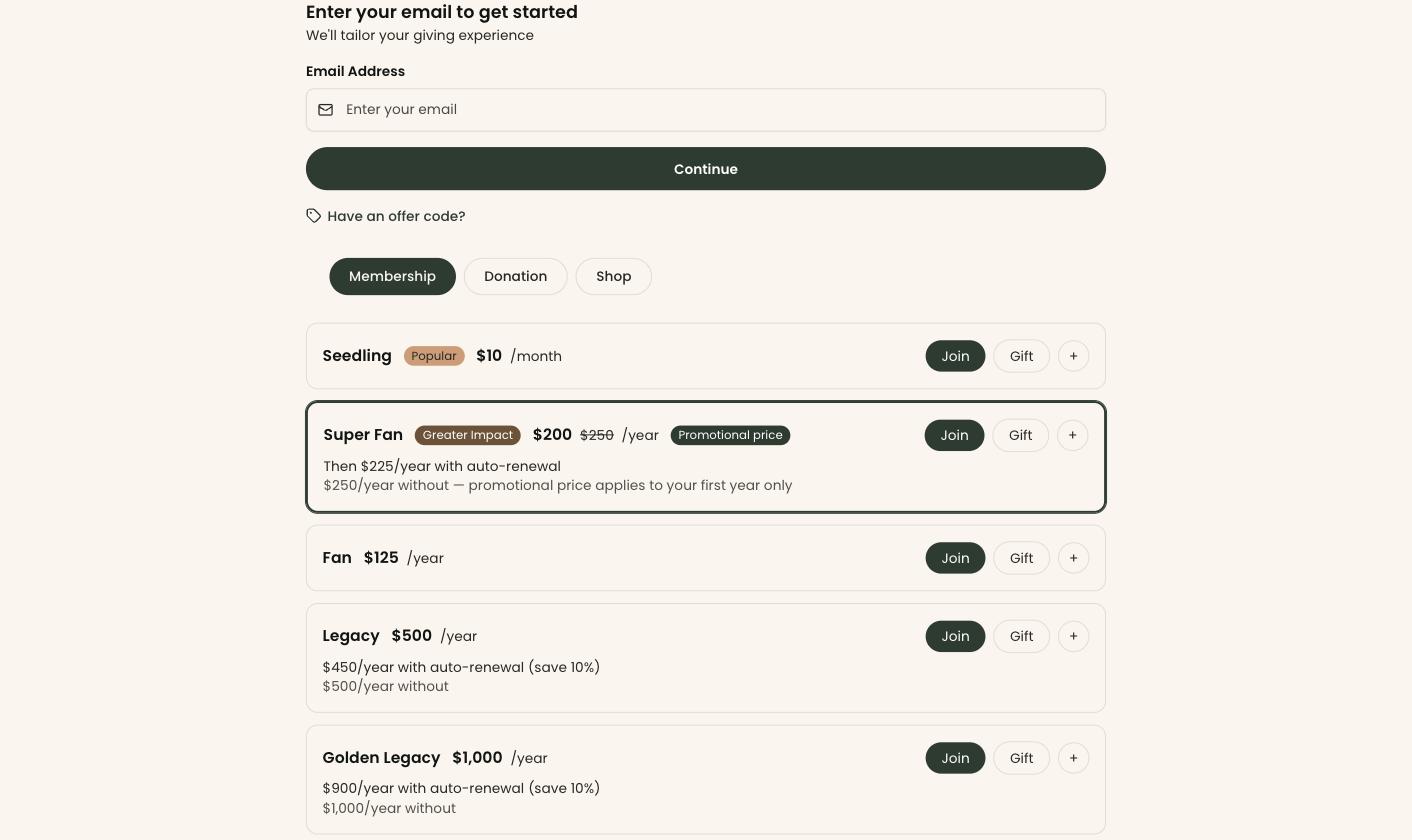
| Memberships as a product with a term and expiry | Yes | Not documented—a search of their help center for "membership" returns release notes and an integration to a different system, and no membership feature article |
| Timed-entry admission | Partly—walk-up admission is sold by price tier, not by time slot; timed sessions with a capacity can be sold as an event series of dated sessions | Not documented—an event carries one date and time, and the published ticket fields carry no time |
| Sales tax on retail items | Yes | Not documented—the ticket builder's tax field is a tax-deductible amount, which is a different thing |
| Online store or gift shop | Yes | Not documented—a help center search for "merchandise" returns nothing |
| Retail inventory reduced automatically by a sale | Yes | Not documented—a help center search for "inventory" returns nothing |
| Self-service kiosk | Yes | Not documented—a help center search for "kiosk" returns nothing |
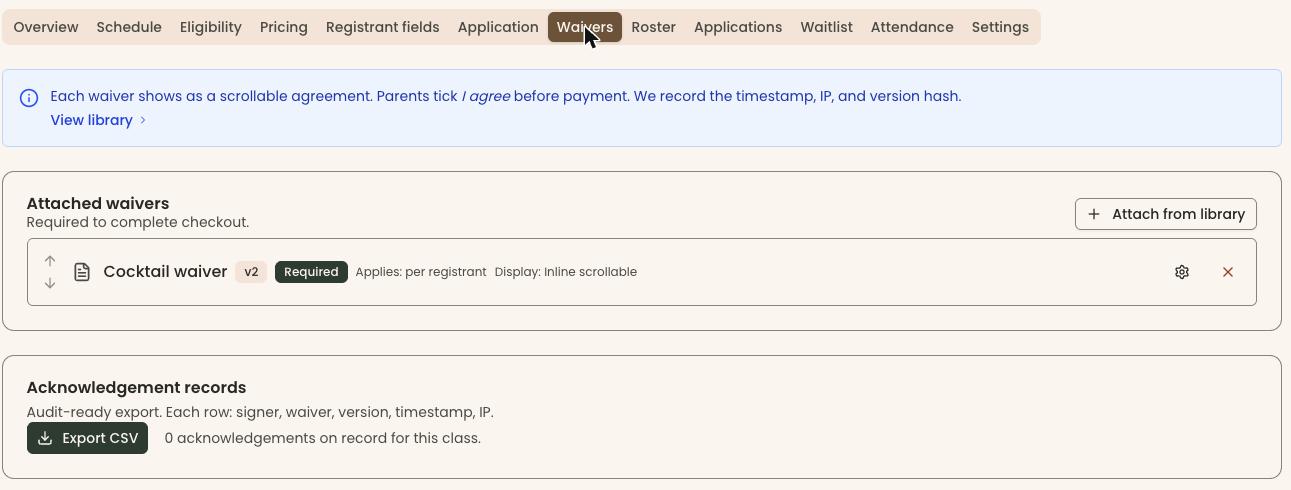
| Liability waiver captured at registration | Yes—versioned, required before payment, with signer, timestamp, IP and version hash recorded | On the roadmap—the only waiver mentions are release notes marked "In Progress" |
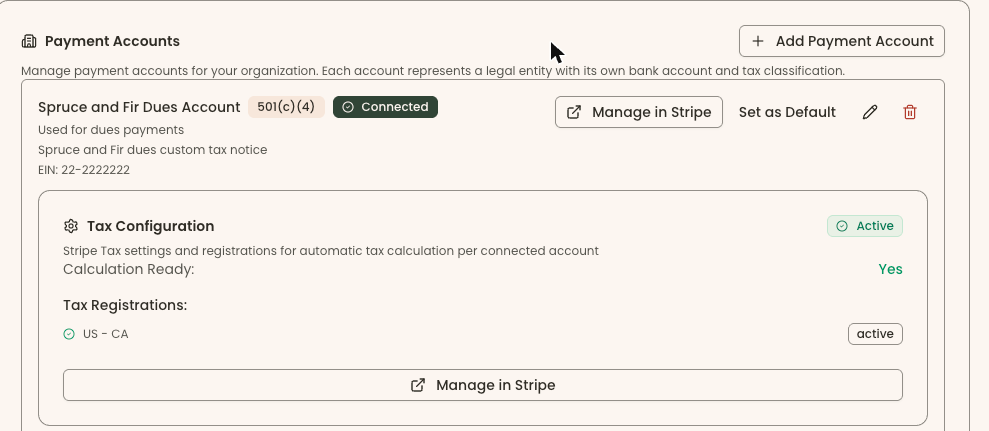
| Correct tax receipt per 501(c) entity, per transaction | Yes | Not documented—one tax ID per organization, with subaccounts as separate accounts |
| Class or workshop registration | Yes | Not documented—registration means event attendee or peer-to-peer fundraiser signup |
| Silent auction with bidding from the guest's own phone | Yes—max bids, buy-now and outbid alerts by email | Yes—a bidding page that works on any phone |
| Live auction and paddle raise recorded by bidder number | Yes—the auctioneer screen shows the winner's name as the number is typed | Partly—paddle numbers for a paddle raise; a live auction recorded by bidder number is not documented |
| Winners charged in one batch from cards saved at purchase or check-in | Yes—plus a pay link for anyone left owing | Yes—payment methods collected up front and top bidders charged at the close |
| Auction receipts showing fair market value and the deductible amount | Yes | Yes—the receipt includes the item's fair market value |
| Raffle tickets sold online and at a table | Yes—singles or bundles, such as 10 for $40 | Not documented |
| Random raffle draw inside the product, with every draw recorded | Yes—a cryptographically random pick, and refunded tickets cannot win | Not in the product—Funraise's raffle wheel is a separate free tool that only draws a winner |
| Raffle money kept out of giving history and never receipted as deductible | Yes | Not documented |
| Move a payment between a membership and a donation, with a corrected receipt | Yes | Not documented—Funraise documents no membership product |
| Membership grace period, and a longer first term or lower first price for late joiners | Yes | Not documented—Funraise documents no membership product |
| Offer codes on event tickets | Yes—percent off, amount off or a fixed price, with caps and date windows | Yes—promo codes on tickets |
| Member pricing applied automatically at event checkout | Yes | Not documented |
Clerestory does twenty-five of the twenty-six in full and timed entry in part. Funraise matches us on ten of them, which is more than most platforms on this list, and we have left those ten in plainly because a comparison that finds the competitor lacking on everything is one nobody should trust. Their in-person setup is real, their ticketing is well built, and they let you bring your own Stripe gateway, which most of this market does not.
We want to be precise here rather than score a point. Funraise's help center contains no waiver feature article. What it does contain is the same line in four separate release notes—April, May, June and August 2026—listed under In Progress: the ability to link waivers in checkbox questions on events.
So the honest reading is that Funraise is building toward it and has been for at least five months. It is not a gap they have ignored; it is a gap that is still open. If waivers matter to you, ask them for a date.
Funraise has recurring subscriptions, which handle a supporter giving monthly. What we could not find documented is a membership: a thing with a level, a term, an expiry date and a renewal. A search of their help center for "membership" returns release notes, a peer-to-peer article, and an integration that connects Funraise to Daxko Operations so donors can be matched to members held in that other system.
For an organization whose members are recurring donors, a subscription is the right shape and Funraise handles it well. For one whose membership expires in March and has to be renewed, with benefits attached, it is a different object.
This is the Clerestory kiosk mid-transaction. Six of the rows above are visible in one screen.

Funraise has the card reader and can take that payment in person. What is not documented on their side is what is being sold: the admission, the shop item, the stock count and the sales tax.

Funraise documents subaccounts, which let a parent organization manage and report on child organizations. What is not documented is each entity carrying its own EIN onto its own receipts; the organization record holds a single tax ID.
In Clerestory each entity is a payment account. Its own EIN, its own tax classification, its own bank account, and its own tax notice on the receipt. Every campaign routes revenue to the account you choose, so the gift lands against the right entity and the receipt carries the right EIN at the moment it is sent.
Funraise documents a real auction: bidding from any phone, payment methods collected up front and charged at the close, and receipts that carry fair market value, plus a paddle raise with paddle numbers. What we could not find is a live auction recorded by bidder number, or a raffle inside the product. Funraise's raffle wheel is a separate free tool that draws a winner and nothing else.
Auctions and raffles are now part of Clerestory, in the same account as memberships, admission and the gift shop. Guests bid on silent items from their own phones, with max bids, buy-now and outbid alerts by email. The auctioneer records live items and paddle-raise levels by bidder number, and a big screen in the room shows the running total and the countdown to each close. After the event every saved card is charged in one batch, with a pay link for anyone left owing. Each guest's statement separates fair market value from the deductible amount, and a paddle-raise gift lands in the donor's giving history as a gift.
Raffles run on their own or inside an event, sold online or at a table. A numbered raffle is drawn inside Clerestory with a cryptographically random pick, and every press of the button is recorded, so a re-draw is visible rather than silent. Raffle money counts as money raised, never as giving, and it is never receipted as deductible.
Memberships and events moved too. Membership rules now cover a shared membership year or a rolling one, a grace period, an early-renewal window, and a longer first term or a lower first price for late joiners. A payment recorded against the wrong thing—a membership paid through the donation form, say—can be moved between membership and donation after the fact without charging anyone again, and the donor receives a corrected receipt that replaces the earlier one. Event offer codes give percent off, an amount off or a fixed price, capped and dated, and signed-in members get member pricing automatically.
Funraise is a well-built fundraising platform with a strong events product, real in-person payment hardware, and unusually open pricing. On ten of the twenty-six rows above it does exactly what we do.
If your organization raises money through donation forms, recurring gifts, peer-to-peer campaigns and a gala, and your in-person work is taking payments rather than selling admission and merchandise, Funraise is built for that.
Two questions decide it the other way.
What is the platform fee, and who pays it? On the free plan it is 5%, preselected onto the donor, and about nine in ten of them absorb it. Ours is 3%, it is a ceiling, and it is the same number whether or not the donor covers it.
Does the institution have a door? A gift shop with stock and sales tax, a membership that expires, a waiver a parent signs, and two EINs on two sets of receipts are all things we could not find documented on Funraise's side. If most of that describes your week, you are comparing a fundraising platform to an operations platform.
If you are large enough that a percentage of everything makes you uneasy, say so early. Our terms already provide for the platform fee to be adjusted or capped at a mutually agreed rate at higher processing volumes, documented in writing between us and published where you can read it before you ever speak to us.
On 3 September 2026 we read Funraise's own pricing page and help center, and verified every quote and every rate above against the live pages in a browser rather than trusting an automated fetch. We did not use G2, Capterra, or any comparison site, and we did not treat marketing pages as evidence of what the software does.
On 29 September 2026 we added eleven rows—auctions, raffles, membership rules, moving a payment and event offer codes—and checked each against Funraise's own site and help center on that date. Where a cell quotes Funraise, the quote is from Funraise's own page.
Where we say something is not documented, we ran the search in Funraise's own help center and read the rendered results. We validated the method first on a term that does return results, so that an empty result means an empty result rather than a broken search.
One thing we deliberately did not claim: Funraise publishes two different figures for its ACH rate in two places, so we have not quoted either. And we make no claim about who the merchant of record is, because Funraise does not publish one.
Corrected 30 September 2026: Clerestory sells admission by price tier, not by time slot; timed sessions can be sold as an event series.
Screenshots labeled Clerestory are from a Clerestory demo organization with test data. Screenshots labeled Funraise are from Funraise's own website. Every quote is reproduced as it stood on 3 September 2026. Documentation moves and products change. If anything here is out of date or wrong, tell us and we will correct it.
Clerestory is an alternative to Funraise for non-profits that sell admission, memberships with a term and expiry, and gift shop items as well as raising donations, all for 3% per transaction. As of 3 September 2026, Funraise's free plan is for organizations raising under $1 million a year and carries a 5% platform fee.
Compared with Funraise's free plan, yes. As of 3 September 2026, Funraise's free plan charges a 5% platform fee plus 2.9% + 60¢ processing, while Clerestory charges 3% plus Stripe processing at 2.2% + $0.30. Funraise's Premium plans carry a 0–3% platform fee, but their price is not published.
Yes. As of 3 September 2026, Funraise charges a 5% platform fee on its free plan and 0–3% on Premium plans, plus 2.9% + 60¢ processing, and American Express costs 1% more. Fee coverage is preselected on its giving forms, and Funraise says about 90% of donors cover fees.
Not as a documented product. As of 3 September 2026, Funraise has recurring subscriptions, but a search of its help center for a membership with a level, a term, an expiry date and a renewal found no membership feature article. Clerestory sells memberships with monthly or annual terms, fixed shared expiry or rolling terms, and a grace period.
On the twenty-six capabilities this comparison checked, none: Clerestory does twenty-five in full and timed entry in part. Funraise matches Clerestory on ten, including a Stripe card reader, ticketing with promo codes, phone bidding and auction receipts with fair market value, and it lets an organization bring its own Stripe gateway, which most of the market does not.