


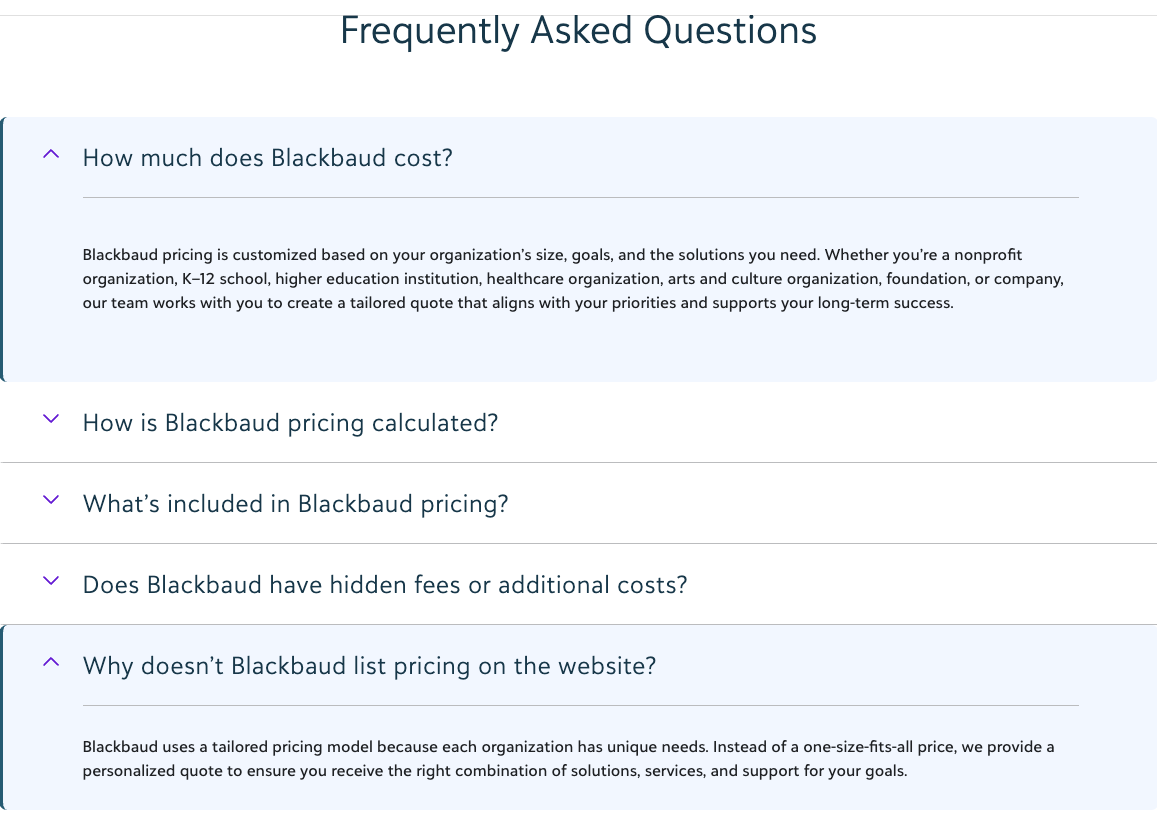
Blackbaud Altru: the pricing FAQ on Blackbaud's own website, read on 3 September 2026. It answers how much Blackbaud costs without naming a figure.
Most comparison pages are written by the company that wants to win, which is why almost none of them are useful. This one is too, so here is how we have tried to make it worth reading: every claim about Altru below is quoted from Blackbaud's own documentation, with the date we read it, and where Altru matches us we say so plainly rather than leaving the row out.
Every screenshot on this page is labeled with whose product it shows.
Blackbaud does not publish a price for Altru. On 3 September 2026 we checked the Blackbaud pricing page, the Altru product page, the Raiser's Edge NXT product page and the Blackbaud CRM page. None carries a figure, a range, or a starting-from number. Each offers a form.
Blackbaud answers the question directly in its own FAQ, which we will quote rather than characterize. Asked "Why doesn't Blackbaud list pricing on the website?" the answer is: "Blackbaud uses a tailored pricing model because each organization has unique needs. Instead of a one-size-fits-all price, we provide a personalized quote to ensure you receive the right combination of solutions, services, and support for your goals."
And asked "How much does Blackbaud cost?", the answer names the variables without naming a number: "Blackbaud pricing is customized based on your organization's size, goals, and the solutions you need." The screenshot at the top of this page is that FAQ, on Blackbaud's own website, exactly as it stood on 3 September 2026.
Card processing they do publish, and they deserve credit for it. Blackbaud Integrated Payments lists 2.99% + $0.30 for Visa, Mastercard, Discover, Diners Club and JCB, 3.5% + $0.30 for American Express, and a $15 chargeback fee. What is not published is the cost of the software.
We are not going to guess at their license price. Anyone who tells you what Altru costs without a quote in front of them is making it up.
3% per transaction, and that is the whole of our price. No license fee, no per-seat pricing, no modules, no support tiers, no minimum and no contract. Stripe processes the payment on your own Stripe account at 2.2% + $0.30, the non-profit rate our customers receive.
Supporters can cover both fees at checkout, ours and Stripe's. Across every payment we processed through August 2026, our customers paid an effective 1.65% platform fee on our 3% once supporters had covered their share, and about 1.5% in Stripe processing.
And 3% is a ceiling, not a floor. Our published Terms of Service say it plainly: "At higher processing volumes, the platform fee may be adjusted or capped at a mutually agreed rate." Three per cent is the most anyone pays us, and it is the only direction the number moves.
Read the right-hand column carefully. "Not documented" does not mean Altru cannot do it. It means we searched Blackbaud's published documentation for it on 3 September 2026 and did not find it. If it exists and we missed it, tell us and we will correct this page.
| Capability | Clerestory | Blackbaud Altru |
|---|---|---|
| Price published on the vendor's own website | Yes, 3% per transaction | No |
| Timed-entry admission | Partly—walk-up admission is sold by price tier, not by time slot; timed sessions with a capacity can be sold as an event series of dated sessions | Yes—"You configure scheduled programs to sell tickets for timed events." |
| Memberships expiring on a fixed shared date, or rolling from purchase | Yes | Yes, both—"To expire the memberships for the program on the same day and month every year, select Is fixed" |
| Walk-up point of sale | Yes | Yes—"The Daily Sales screen is designed for efficiently processing walk-up sales" |
| Sales tax on retail items | Yes | Yes—"you must add each required tax to the system and configure the rate" |
| Card readers and in-person hardware | Yes | Yes—hardware documented; no price published |
| Donor or member option to cover processing fees | Yes | Yes |
| Retail inventory reduced automatically by a sale | Yes | Not documented—every inventory change we found documented is operator-initiated |
| Self-service kiosk | Yes | Not documented in Altru, Raiser's Edge NXT or Blackbaud Merchant Services |
| Liability waiver captured at registration | Yes—versioned, required before payment, with signer, timestamp, IP and version hash recorded | Not documented—a registration notice/disclaimer field exists, documented as display text with no acceptance step described |
| Correct tax receipt per 501(c) entity, per transaction | Yes | Not documented |
| Process on your own Stripe account | Yes | Not documented—online donation forms are documented as requiring an active Blackbaud Merchant Services account |
| Silent auction with bidding from the guest's own phone | Yes—max bids, buy-now and outbid alerts by email | Not documented |
| Live auction and paddle raise recorded by bidder number | Yes—the auctioneer screen shows the winner's name as the number is typed | Not documented |
| Winners charged in one batch from cards saved at purchase or check-in | Yes—plus a pay link for anyone left owing | Not documented |
| Auction receipts showing fair market value and the deductible amount | Yes | Not documented |
| Raffle tickets sold online and at a table | Yes—singles or bundles, such as 10 for $40 | Not documented |
| Random raffle draw inside the product, with every draw recorded | Yes—a cryptographically random pick, and refunded tickets cannot win | Not documented |
| Raffle money kept out of giving history and never receipted as deductible | Yes | Not documented |
| Move a payment between a membership and a donation, with a corrected receipt | Yes | Yes—a payment's application can be changed to a different revenue type |
| Membership grace period, and a longer first term or lower first price for late joiners | Yes | Partly—a grace status is documented; proration is not |
| Offer codes on event tickets | Yes—percent off, amount off or a fixed price, with caps and date windows | Yes—promotion codes on tickets |
| Member pricing applied automatically at event checkout | Yes | Yes—discounts restricted to members and applied automatically |
Clerestory does twenty-two of the twenty-three in full and timed entry in part. Altru does nine of them, and we do eight of those nine in full too. The one Altru does that we do only in part is timed-entry admission. We have left it in plainly, with the eight matches, because a comparison that finds the competitor lacking on everything is one nobody should trust. On most of the remaining fourteen we could not find documentation that Altru does them at all.
This is the Clerestory kiosk mid-transaction. It is worth looking at closely, because several of the rows above are visible in one screen.

Admission, retail and a donation are in the same cart, on the same tap, against the same member record. That is the part worth weighing against Blackbaud: on their side, admission and the gift shop are Altru, and fundraising is Raiser's Edge NXT.
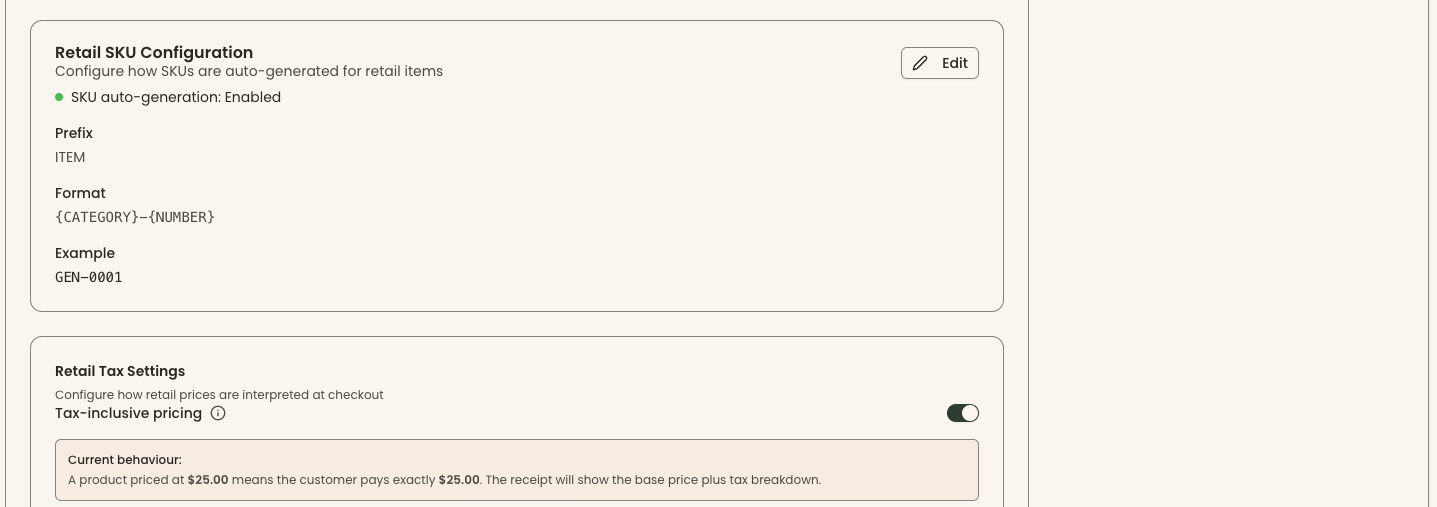
Collecting a tick box is easy. The question an insurer or a court asks is what you can produce afterwards.
Altru documents a registration notice or disclaimer with two fields, a name and its content. What its documentation does not describe is any acceptance step by the registrant—no tick, no signature, no record of assent. It reads as display text.
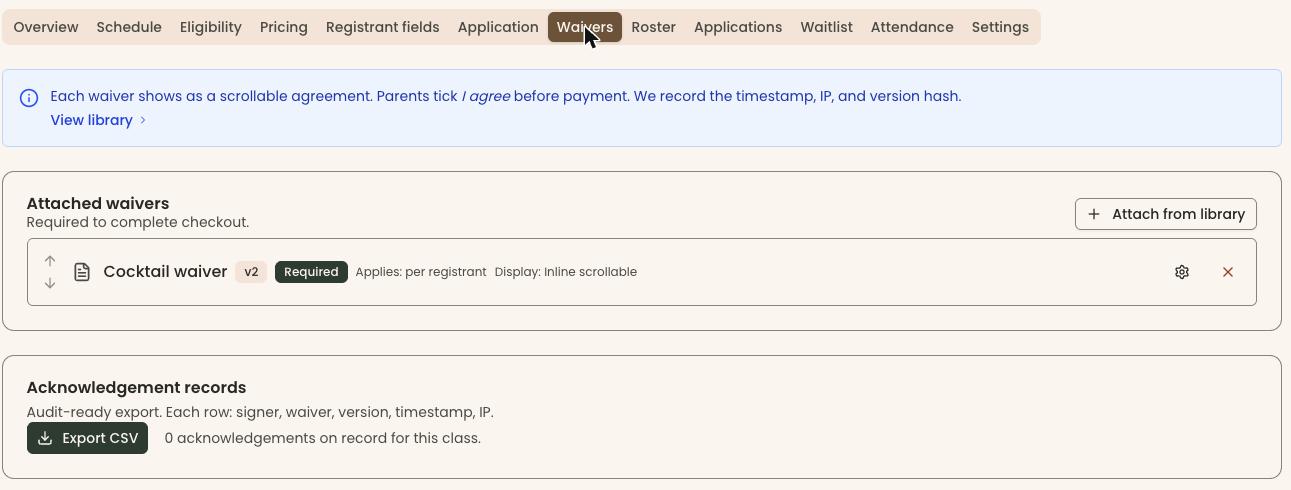
The version hash matters more than it sounds. If you revise a waiver mid-season, you can still show which wording a given family actually agreed to.
A museum and its foundation. A society and its endowment. A club and its charitable arm. Two legal entities, two EINs, and every dollar has to land against the right one.
Blackbaud's documentation for Raiser's Edge NXT describes support for one primary tax ID plus one alternate, set at the level of the whole environment. The wording is worth reading closely: "You may need an alternate tax ID that appears on receipts and giving statements if your organization references more than one tax ID in parts of the organization that were merged or acquired." And changing the primary one is not self-service: "Blackbaud uses your organization's primary tax ID to verify your non-profit status. To change it, contact Support."
That treats a second entity as the residue of a merger to be tolerated, rather than a way an institution might simply be built.
In Clerestory each entity is a payment account. It has its own EIN, its own tax classification, its own bank account, and its own tax notice on the receipt. Every campaign routes its revenue to the account you choose, so the gift lands against the right entity and the receipt carries the right EIN at the moment it is sent, rather than being corrected afterwards. Each account can carry its own reply-to address too, so a question about the 501(c)(3) reaches a different person from a question about the 501(c)(6).
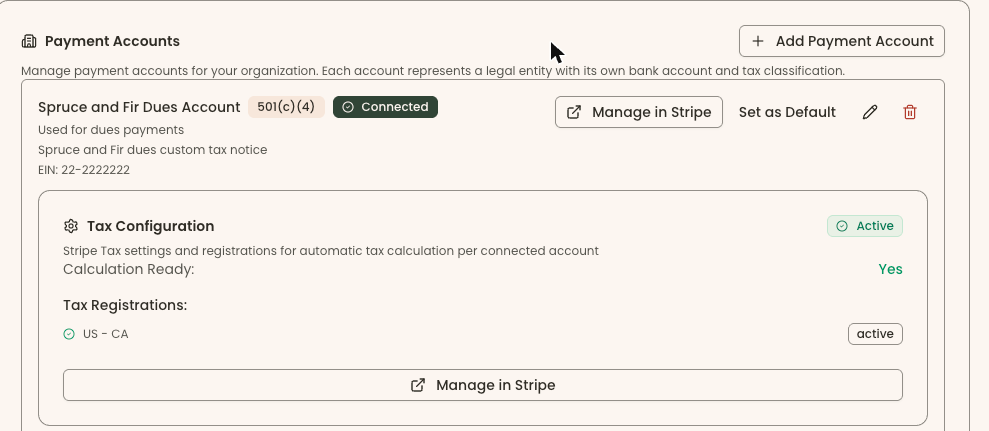
It also works the other way, for a single entity that wants separation: memberships and general donations into one bank account, a scholarship fund or a gala into another. And if you operate under a fiscal sponsor, you write the tax notice that explains the relationship rather than accepting a default that does not describe you.
You move between them from one login. There is no ceiling of two, and there is no support ticket in the process.
Raiser's Edge NXT has no retail module, no timed ticketing and no walk-up point of sale. Those are Altru. An institution on Raiser's Edge that wants to sell timed admission or run the gift shop is looking at a second Blackbaud product, at a second price that is also not published.
It is worth knowing which product a quote actually covers before you compare it to anything.
Altru's documentation does not mention auctions or raffles. The Blackbaud help pages that do describe auctions belong to Blackbaud CRM, a different product. On the membership and ticketing rows Altru is strong: promotion codes, discounts restricted to members and applied automatically, a grace status, and a payment whose application can be changed to another revenue type.
Auctions and raffles are now part of Clerestory, in the same account as memberships, admission and the gift shop. Guests bid on silent items from their own phones, with max bids, buy-now and outbid alerts by email. The auctioneer records live items and paddle-raise levels by bidder number, and a big screen in the room shows the running total and the countdown to each close. After the event every saved card is charged in one batch, with a pay link for anyone left owing. Each guest's statement separates fair market value from the deductible amount, and a paddle-raise gift lands in the donor's giving history as a gift.
Raffles run on their own or inside an event, sold online or at a table. A numbered raffle is drawn inside Clerestory with a cryptographically random pick, and every press of the button is recorded, so a re-draw is visible rather than silent. Raffle money counts as money raised, never as giving, and it is never receipted as deductible.
Memberships and events moved too. Membership rules now cover a shared membership year or a rolling one, a grace period, an early-renewal window, and a longer first term or a lower first price for late joiners. A payment recorded against the wrong thing—a membership paid through the donation form, say—can be moved between membership and donation after the fact without charging anyone again, and the donor receives a corrected receipt that replaces the earlier one. Event offer codes give percent off, an amount off or a fixed price, capped and dated, and signed-in members get member pricing automatically.
We are not going to pretend Blackbaud is a bad product. Altru is mature, it is deployed across the cultural sector, and on eight of the twenty-three rows above it does exactly what we do. On one more, timed-entry admission, it does something we do only in part.
If you are large enough that a percentage of everything makes you uneasy, say so early. Our terms already provide for the platform fee to be adjusted or capped at a mutually agreed rate at higher processing volumes, documented in writing between us. That is published in our Terms of Service, where you can read it before you ever speak to us, rather than being something you have to discover you are allowed to ask for.
Then ask both of us the same two questions: what does the software cost, and what does the card processing cost, each on its own line? Ours are 3% and 2.2% + $0.30, and your supporters can cover both. Blackbaud publishes its processing rate but not its license price or its billing unit, so half of its answer is missing. That is not a small difference when you are the one who has to defend the number to a board.
On 3 September 2026 we read Blackbaud's own help center, knowledgebase and user-guide PDFs for Altru and Raiser's Edge NXT, and verified the quotes above against the live pages in a browser rather than trusting an automated fetch. We did not use G2, Capterra, or any comparison site, and we did not treat Blackbaud's marketing pages as evidence of what the software does. That distinction matters, because it is where most competitor comparisons go wrong.
On 29 September 2026 we added eleven rows—auctions, raffles, membership rules, moving a payment and event offer codes—and checked each against Blackbaud's own help center and user guides on that date.
Corrected 30 September 2026: Clerestory sells admission by price tier, not by time slot; timed sessions can be sold as an event series.
Screenshots labeled Clerestory are from a Clerestory demo organization with test data. Screenshots labeled Blackbaud Altru are from Blackbaud's own website or documentation. Every quote is reproduced as it stood on 3 September 2026. Documentation moves and products change. If anything here is out of date or wrong, tell us and we will correct it.
Clerestory is an alternative to Blackbaud Altru that sells admission by price tier, memberships, the gift shop and donations in one cart, and runs auctions, raffles, a self-service kiosk and liability waivers that Altru's documentation does not describe, for 3% per transaction with no contract. Clerestory does timed-entry admission only in part, which Altru does in full: walk-up admission is sold by price tier, not by time slot, and timed sessions can be sold as an event series. As of 3 September 2026, Blackbaud does not publish a price for Altru.
Altru's software cost cannot be worked out from anything Blackbaud publishes, because the license price is not published. As of 3 September 2026, Blackbaud publishes card processing at 2.99% + $0.30, and 3.5% + $0.30 for American Express. Clerestory publishes both of its fees: a 3% platform fee, and Stripe processing at 2.2% + $0.30, and supporters can cover both.
Blackbaud does not publish a price for Altru; as of 3 September 2026, its FAQ says it uses a tailored pricing model with a personalized quote. Clerestory charges 3% per transaction on the organization's own Stripe account, plus Stripe's processing, with no license fee, no per-seat fee and no contract.
Not according to its documentation. As of 29 September 2026, Altru's documentation does not mention auctions or raffles, and the Blackbaud help pages that describe auctions belong to Blackbaud CRM, a different product. Clerestory runs silent and live auctions, paddle raises and raffles in the same account as memberships and admission.
Timed-entry admission, in full. Of the twenty-three capabilities this comparison checked, it is the one Altru does and Clerestory does only in part: Clerestory sells walk-up admission by price tier, not by time slot, and a museum can sell timed sessions with a capacity as an event series of dated sessions. Clerestory does the other twenty-two in full. Altru matches Clerestory on eight, including fixed or rolling membership expiry, walk-up sales, sales tax, promotion codes and member pricing applied automatically.